Beltane
Beltane
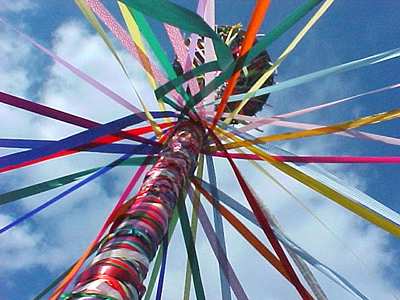
Beltane Maypole
Beltane is an old Celtic Fire Ritual which celebrates, at the most fundamental level, the end of winter and the beginning of the warmer, lighter half of the year. It is the counterpart to Samhain, which marks the Pagan New Year and celebrates ancestors and the death of the crops (harvest). Beltane celebrates life. For the Celts, it was a festival that insured fertility and growth.
Beltane is one of the four major Sabbats in the Celtic tradition, the other three being Lammas, Samhain and Imbolc. Beltane’s traditional date, May 1st, was chosen as the midway point between the vernal equinox and summer solstice (two of the four minor Sabbats). Due to the change in the earth’s axis of rotation over time, this point is now closer to May 5th, and some pagans observe May 5th as “Old Beltane,” but the traditional date is still favored.
Beltane, much like Samhain, has changed over the years. Some traditions existed only in a single village, while others were found throughout the culture. It is believed that Beltane is a Celtic reinvention of an even older Roman festival, Floralia, which celebrated the goddess Flora and the flowering of spring. Most major religions have a holiday that marks the coming of spring. The Christian religion celebrates rebirth (or resurrection) on Easter; Easter eggs, Easter bunnies, chicks, and lilies are all pagan symbols of fertility associated with spring, adapted to the Christian tradition. The Hindu religion celebrates Holi, a carnival-like spring festival, dedicated to Krishna or Kama, the God of Pleasure. This festival resembles Beltane, with bonfires being a main focus of the holiday.
Traditionally, Beltane festivities began days before May 1st or “May Day,” when villagers traveled into the woods to gather the nine sacred woods needed to build the Beltane bonfires. The tradition of “May Boughing” or “May Birching” involved young men fastening garlands of greens and flowers on the windows and doors of their prospective ladyloves before the fires are lit Beltane night. As with many Celtic customs, the type of flowers or branches used carried symbolic meaning, and much negotiating and courting could be worked out ahead of time.
Many communities elected a virgin as their “May Queen” to lead marches or songs. To the Celts, she represented the virgin goddess on the eve of her transition from Maiden to Mother. Depending on the time and place, the consort might be named “Jack-in-the-Green” or “Green Man,” “May Groom” or “May King.” The union of the Queen and her consort symbolized the fertility and rebirth of the world.
The tradition of choosing a symbolic goddess and god as official participants in the Beltane ritual captured Marion Zimmer Bradley’s imagination in her novel The Mists of Avalon. In Bradley’s retelling of the King Arthur legend, the Beltane celebration is a sacred ritual involving a high-ranking male and female virgin to represent the God and Goddess. The god in this case is called the “King Stag”; he must run through the woods with a pack of deer, followed by his own huntsmen, and only after he has successfully locked antlers with and killed a stag that he can return to the festival and claim his right as consort to the Goddess. Other couples also celebrate in this way, but it is only these two who become the God and Goddess incarnate.
Because the Celtic day started and ended at sundown, the Beltane celebration would begin at sundown on April 30th. After extinguishing all hearth fires in the village, two Beltane fires were lit on hilltops. The villagers would drive their livestock between the fires three times, to cleanse them and insure their fertility in the coming summer, and then put them to summer pasture. Then the human part of the fertility ritual would begin.
As dancing around the bonfires continued through the night, customary standards of social behavior were relaxed. It was expected that young couples would sneak off into a ditch, the woods or, better yet, a recently plowed field for a little testing of the fertility waters. Even after hand-fasting was replaced by the Christian tradition of monogamous marriage, the Beltane ritual continued with a new tradition: all marriage vows were temporarily suspended for the festival of Beltane. Many a priest would lament the number of virgins despoiled on this one night, but the tradition persevered. Babies born from a Beltane union were thought to be blessed by the Goddess herself.
Another use of the Beltane fires was for a purification ritual using a scapegoat or Fool. Special cakes made out of egg, milk and oatmeal, called bannocks, were passed around in a bonnet. One piece of bannock was charred, and whoever chose this piece was the Fool for that year’s Beltane; it was believed that any misfortune would fall on the Fool, sparing the rest of the people. It is now generally believed to be a myth that the Fool was ever burned as a human sacrifice; this seems to have stemmed from Christian priests and their attempts to condemn Beltane festivities. Later customs called for the Fool to leap three times through the Beltane fire, and according to earlier customs the Fool was banned from all Beltane activity.
Beltane, like Samhain, is a time when the veil between the worlds is thought to be thin, a time when magic is possible. Whereas Samhain revelers must look out for wandering souls of the dead, Beltane merrymakers must watch for Fairies. Beltane is the night when the queen of the fairies will ride out on her white steed to entice humans away to Faeryland. If you hear the bells of the Fairy Queen’s horse, you are advised to look away, so she will pass you by; look at the Queen and your sense alone will not hold you back! Bannocks were also sometimes left for the Fairies, in hopes of winning their favor on this night.
The maypole, which was either a permanent feature or cut in a ceremony during the gathering of the nine sacred woods, was a symbolic union of the God and Goddess. The maypole itself represented the male, a phallus thrust into mother earth, while the ribbons that were wound around it represent the enveloping nature of the woman and her womb. The maypole was usually danced after sunrise, when disheveled men and women would stagger back into town carrying flowers they picked in the forests or fields. The area around the maypole was decorated with the flowers, and then the winding of the ribbons would begin. Sometimes the flowers were put into baskets and left on the doorsteps of people who were too ill or old to attend the Beltane celebrations. In this way, the entire town could participate in the joys of the coming spring.
It is traditional to wash your face in the dew of Beltane morning. It is thought that it brings health and luck, and, in the case of young women, guarantees against fading beauty.
You don’t have to have large acres of land to frolic in to celebrate Beltane. In fact, you may have already been a part of a Beltane celebration if you’ve ever attended a May Day party. Throwing your own Beltane or May Day party is a great way to celebrate the coming spring. These days, a celebration of fertility does not necessarily mean your goals are human reproduction. Perhaps you have a garden that you would like to grow well this season; if you have a private enough yard (and a lover), making love in the garden is a way of honoring and insuring the fertility of the seeds you have planted. Make a wreath of flowers or fragrant herbs — rosemary is a nice smelling one that tends to grow in abundance — and weave a wreath for someone you’d like to know better. Or maybe there are projects you’d like to complete, goals you need to reach for, dreams you’d like to see realized. All of these things can benefit from the Beltane celebration of growth and fertility.
Any Beltane party should have as many flowers as you can afford. If you have a garden, or a deck or porch with container gardens, you should include this as part of the party space and make sure you’ve planted your spring flowers in time for May 1st. Six-packs of spring flowers at your local garden store should run you no more than several dollars (and often less than two), and can add color and life to your Beltane atmosphere. You can even freeze flowers in the ice cubes for your punch. Edible flowers can add a fairy-like feel to your food table at a Beltane party. Any fruit is appropriate for a Beltane spread, especially cherries, figs, mangos, peaches, pomegranates, and apricots, which have all been long associated with sensuality and/or fertility. Spring greens are another healthy way to imply fertility and celebrate springtime. Chocolate and other sweets are always a good means of tempting your guests at any Beltane party.
Dancing a maypole is the most traditional way of celebrating May Day. Go to your local hardware store and buy a 20-foot wood pole (more rural folk can cut it themselves, but be sure to take a moment to honor the tree that gives the sacrifice). Ask your guests to bring their own ribbons, 20 feet in length and about two inches wide, in any color (and be sure to have several extras on hand anyway). At the party, tie all the ribbons to the top of the pole (you may want to buy an eye hook to make this easier) and plant the other end of the pole several feet into the ground. Have everyone form a circle, and count off in twos; have the “ones” face clockwise and the “twos” face counterclockwise. Have everyone grasp their partner’s right hand, then pass them by on the right. Now, grasp left hands and pass by on the left. Then right, then left, and so on. Once you’ve made it once around the circle, pick up your ribbons and begin again, this time weaving your ribbons as you go.
You’ll want to have music once you start the actual weaving of the maypole. If you have talented friends who don’t mind sitting out the maypole dancing itself (and certainly that’s an option, especially if you’re superstitious about pregnancy at this time of year), live music is the nicest way to go. Singing is good, too; if you choose to sing, you might want to consider sending out lyrics with the invitations, and sing the tune to your friends over the phone. This might be a good way to find out how much you can count on singing to carry the music ’round the maypole, too.
Even if you don’t have live music, the technological age makes sure nobody has to sing or miss out in order to have some music. A CD or tape of any Celtic music will do, but I also suggest searching out bands with specific May songs. You can sing along, or just listen and enjoy as you skip around the maypole. “Welcome in the May,” by Annwn, is a fun, bouncy song that would be appropriate. It describes a typical old Beltane night:
We were there last night when the dark drew down:
we set the bonfires leaping.
Then we vanished in the heather
and we couldn’t be found until the dawn came creeping.
If you have the space and the zoning, have a Beltane fire after sundown. It should be lit from flint or friction, but matches can count as friction too. Again, drumming or singing around the Beltane fire is a traditional way to celebrate Beltane. Go around and talk about things in your life that you want to have grow in the following season. It might be your life’s dream of becoming a painter, or your physical activity, or your relationship with a loved one. It might even be a baby you’re trying to have; there’s no better time than Beltane to ask the gods for fertility!
Later, if people sneak off, make sure that the fire is not left unattended. If this is likely to happen at your party, you may think about researching different ways to handle that kind of party. Or, perhaps, you can wait until after the party, when you can frolic naked with your loved one(s) in private. This is certainly my favorite, and probably the most appropriate, way to end Beltane. And you may find, with the leaping fire and the well-wrapped maypole urging you on, it is inevitable; as the Annwn chorus goes:
Did it get a little warm around the fire last night?
Were the flames a little higher than they had the right?
Was your breath a little heavy and your dress a little tight
and the moon too bright for sleeping?
Blessed Be


Posted in Sabbats, Wicca and tagged Beltane, Magickal Winds, pagan, Sabbat, Wicca by admin with no comments yet.
WICCA – An Old Religion in a New Age
WICCA
An Old Religion in a New Age
“When I was young, I felt that when I was in a church, I was close to God. Not too far away from my home was a beautiful park with rolling hill of grass outlined with many red and yellow flowers and trees. There, I felt close to Mother Nature. How strange, I thought, that God was in a building made by man and Mother Nature was outside with the flowers. That is when I felt that there had to be a Goddess as well.”
The Religion of Wicca
For almost two thousand years, the major religions of the western world have seen deity as a single god representing the spiritual father. Statements and attitudes attributed to Him are male oriented and reflect the general social attitude of mid-Eastern societies. In the last few decades, a religion that had its start in Europe made it’s way into America. It taught that deity was made of both God and Goddess and that they were equal, neither superior to the other. It taught that mankind was not the owner of the world or the creatures of the world but instead that we were all brothers and sisters of all living beings. This religion is now called Wicca, but it embraces the teachings of many ancient religions.
Many people who did not understand this new religion, called it worship of the devil, but Wicca has no devil. Instead, it teaches love and respect for nature and all living things as well as the Earth itself. It does not separate people into sinners and saved but instead emphasizes the beautiful nature within each of us. We were born not with sin, but from the passion and loving union of two people. Mankind may have hate, but it also has love. We humans may often hurt each other, but we try to heal each other as well.
In just a few short years, Wicca has grown quickly and is one of the fastest growing religions. It is not a religion of established churches, but of ordinary people. These are the people who have walked into the meadow and looked for the Goddess; people who have seen the magic of nature and have found it beautiful and worthy of deep respect.
In the early villages in Europe, the women practitioners were called ‘wise women’ and men either ‘wise men’ or ‘cunning men’. These were people who lived in the village and were knowledgeable of the local herbs and how to use their curative powers. They were also the ones who gave advice and helped others deal with the problems of life. Often, they were old since the wisdom they had took many years to develop. The word ‘witch’ evolved from the older names.
When church missionaries came north to the country villages in northern Europe, they were threatened by the respect the village people had for their healers, so many missionaries called the village wise women and men worshipers of the devil, heretics and practitioners of evil witchcraft.
This later became a wholesale torture and killing of up to many thousands of people during the years of the inquisition. This time of horror lasted from 1233 with the first Papal ordinance directly dealing with witchcraft until 1782 with the last burning of a witch, 549 years!
Another term that was marginalized was the word ‘pagan’. Pagan does not mean atheist or devil worshiper. It simply means that the person is of a religion other than Jewish, Christianity or Islam. In this regard, Shintoism of Japan, Taoism of China and Hinduism of India are all pagan religions. The first religion in the North American hemisphere was pagan, the religion of the Native Americans. ‘Pagan’ comes from the Latin word for countryman or country dweller and referred to the people who lived in the countryside.
Wicca is a pagan religion as are most religions. A pagan religion is usually, but not always, polytheistic or possessing more than one god. In Wicca, we believe that there is both female and male aspects of deity and this is enough for us to think in terms of Goddess and God. The God and the Goddess are not distant beings, but are actively around us in terrestrial and celestial nature and in all living things. It is not unusual for us to greet another in a religious celebration with the greeting ‘Thou art God’ or ‘Thou art Goddess’ as a recognition of the deity within each of us.
Celebrations and Worship
Our worship is in a circle with people facing each other. Since deity is within each of us, facing each other seems more natural than being in an audience style arrangement of a church congregation where the priest or minister is the focal point. Since Wiccan do their own ritual, we are all priests and priestesses. Deity is within each of us; we need no intermediary person to make a divine connection for us.
We honor the celestial aspect of deity by celebrating the solar and lunar events. The sun is projective and is a representation of the God. The moon is softer and has a monthly cycle, so it is a good representation of the Goddess. Instead of praying before a statue of the God or the Goddess, it seems more natural to us to feel the rays of the sun or raise our hands to the light of the moon when we pray. We prefer to worship outdoors if possible.
We have two kinds of regular rituals. One type is the sabbat. There are total of eight sabbats, four are celebrations of a solar events like the equinoxes or the solstices. These are: Yule (winter solstice), Ostara (spring equinox), Litha (summer solstice) and Mabon (fall equinox). These are held close to the time of the event. The other sabbats are the Celtic celebrations of Samhain, Imbolc, Beltane and Lughnasadh.
One of the most important sabbats is Samhain (pronounced ‘sow-wane’). It is an important celebration of our ancestors who have left the world of the living, but still live in our hearts. We honor those of our families that have passed over with a ‘dumb supper’. This is a place setting at our dinner table for Uncle Jim or Grandmother Judy so that we can show their spirits that they are still loved by us and not forgotten. Unfortunately, those who wish to believe that we pray to the devil also say that Samhain is a celebration of Sam Hain, the god of the underworld. There is no Sam Hain; Samhain means ‘summers end’ in the ancient tongue. Although Samhain is celebrated in early November (variously the 1st to the 14th), it is not the same holiday as Halloween. Halloween is the night before All Saints Day, a day that was moved to November 1st by Pope Gregory around 835 AD and is thus a Christian holiday.
Another major celebration is Beltane (pronounced in the US as ‘bell-tane’ although this is not the traditional pronunciation). Beltane is a celebration of life and springtime. We think of it as the time when the Goddess and the God wed. It is held on May 1st and is usually celebrated with a dance around the maypole. The remaining sabbats are Imbulc, the celebration of the return of the light on the February 1st and Lughnasadh, the celebration of the first harvest on August 1st .
In addition to the sabbats are the esbats or moon celebrations. Depending on the tradition, the esbat may be celebrated on the night of the full moon or the night of the new moon or both. It is the time for private work such as healings and blessings rather than celebrations.
Other rituals include one of the most beautiful of rituals, the Handfasting. This is a celebration of the union of two people and may be done as a legal marriage. The two people to be handfasted face each other rather than the altar since the focus of each is on the other person, again because deity resides within. The beauty of the handfasting is apparent to those who have never seen a Wiccan ritual and is a wonderful way to be introduced to the religion.
Ethics of Wicca
There is no devil in Wicca, but we do recognize that there are individual actions that can result in harm to oneself or others. Since we recognize deity in each person, harm to a person is harm to deity as well. As a result, we feel we need only one commandment, and that is the Wiccan Rede (‘rule’). The rede states: An it harm none, do as that wilt. This is an old English wording that means that whatever is your will to do, it should not harm anyone. Not yourself and not another. This places the responsibility of what you do upon your own shoulders.
We also believe in the ‘three-fold’ law. It is a law of consequence that states that what is done to others will return three-fold. If you do evil, it will return to you with a much greater force. If you do good, then your rewards will be three-fold. Will it be immediate or in the same vein? Perhaps, perhaps not. It only states that it will return.
Why do we use the word Witch?
The biggest reason is this: There is history that shows that the wise woman or wise man of the European village was a respected healer with herbs and words. This person was the village shaman. Although there has been much evolution, Wiccan history shows a tradition that dates back to these village shamans. Although much has been lost to history, especially during the Inquisition, there is still much that has remained handed down in families.
Why do we continue to use words like witch, pagan, and magick that have such negative connotation? These were the words that were once used before the evil of the inquisition subverted them and tried to turn them into something evil. Words are not evil. Hate is evil and so is intolerance. Wiccans simply do not wish to empower these evils by accepting false allegations. It is hate that must be avoided, not words.
Basic Points about Wicca:
- Wiccans do not perform black magic. We believe that what you do will return to you three-fold and we are bound by the Wiccan Rede.
- Wiccans do not sacrifice animals in ritual. Most of us love animals, many of us are vegetarians because we do not wish an animal killed for our food. We see deity in all life, including animals.
- Wiccans do not worship the devil. Satan is an entity in Christianity, Judaism and Islam. We have no such concept in Wicca nor is there one in Hinduism, Buddhism, Sikism or any other pagan religion except Zoroasterianism from where the concept originated.
- Wiccans do not perform ‘black masses’. These are parodies of a different religion and we respect other religions. Our celebrations are instead positive and beautiful celebrations of the human spirit.
Printed by:
The Church of Iron Oak, ATC
Box 060672
Palm Bay, FL 32906-0672
Phone: (321) 722-0291
Fax: (321) 724-9693
Email: CIO@ironoak.org
Web page: www.ironoak.org
Blessed Be!
Posted in Wicca and tagged Magickal Winds, New Age, Old Religion, pagan, religions, Wicca by admin with no comments yet.