All About Lughnasadh / Lammas
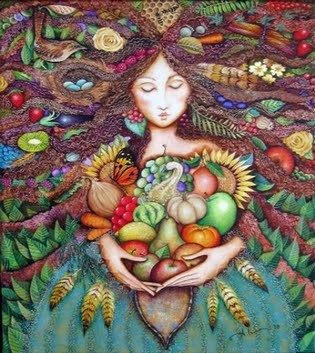
All About Lughnasadh
Posted and edited by: Magickal Winds
[Please keep in mind that these Bulletins & Blogs contain some of my writings and some borrowed (with permission) from different sources, or a combination of both to provide diversity, variety and a broad spectrum of information.]
Lughnasadh
by Christina
At Lughnasadh, the Wheel of the Year begins to shift from growing time to harvest time. The subtle changes of the waning sun that occurred at Summer Solstice becomes more evident as the balance of day and night seem to shift more dramatically. The slight seasonal changes in weather, and the declining arc of the sun, the southern movement of it rising and setting are other indicators of this shift. “After Lammas, corn ripens as much by night as by day.”
Although temperatures can still be high, the mood and sensation of the year most decidedly changes. We enter the harvest time. It is the point in time when the first grains are collected and ritualistically sacrificed to ensure the continuance of the cycle of life both physically and spiritually.
In times past, fertility magic at Lughnasadh guaranteed the continued ripening of crops and bountiful harvest season. Festivities typically centered on the assurance of a plentiful harvest season and the celebration of the beginning of the harvest cycle. A bountiful harvest insured the safe passage of the tribe through the upcoming winter months. The gathering of bilberries is an ancient ritual symbolizing the success of the Lughnasadh rituals. If the bilberries were bountiful the crops would be also.
Lughnasadh celebration is associated with John Barleycorn, an anthropomorphized image of the barley grain that goes into making malt beverages that heeds us to the larger life mysteries that play out each year on the stage of the agricultural cycle from which we spin our Wheel of the Year. Although the life mysteries are deep and contemplative, John Barleycorn also reminds us that levity, joy and festivity are as much a part of the Wheel and our lives as Death and Rebirth. It is what makes life worth living and allows us to touch the Joy that is creation.
Lughnasadh is a time of personal reflection and harvest, of our actions and deeds, events and experiences, our gains and losses. A time when we begin the cycle of reflection of that which is our life. A period for personal fertility magic to ensure the bountiful harvest of life’s gifts and experiences, that which we have reaped though trial, tribulation, enjoyment, joy, love and loss. As my Elder once said to me, “We can not know what we have not experienced.” Such is the truth of life ö we become not by chance but by experience. Each experience opens a window into ourselves, into who we were, who we are, and whom we are choosing to become.
The festival of Lughnasadh is named in honor of Lugh, by his Irish name. He is also know as and associated with: Lug (Continental), Llew, Lugos (Gallic), Lleu Llaw Gyffes (“The Lion of the Sure/Long Hand” Welsh), Ildanach and Lugh Lamfada (“Lugh of the Long Arm/Hand”). He is also associated with the Roman God Mercury, there are many names through many cultures. Lugh is “The God of Light”, “God of All Skills”, the “Bright or Shining One”; He is associated with both the Sun and agricultural fertility.
Lugh led the Tuatha De Danann to victory in the second Battle of Magh Tuireadh. His name was left throughout the Celtic lands on various places, Lug-dunum (present day Lyon, France), Luguvallum (Roman Britain), indicating the impact Lugh has had on all the Celtic peoples. Stories of his conception, birth, naming, exploits, victories and descendents fill pages of Celtic myth. Lugh is indeed a tremendous personality with considerable influence in Celtic lore. Through lore and myth we can journey aside Lugh, delving deeper to his life and journeys and our own.
The origins of the games of Lughnasadh, often referred to as: the Assembly of Lugh; Games of Lug; Games of Sovereignty, are, however, more closely associated with Lugh’s foster-mother/nurse, Tailtiu. Tailtiu is said to be daughter of the King of Spain, wife of Eochaid of the Tuatha de Danaan and is recognized as a Celtic Earth Goddess. She cleared the field at Coill Chuan in Ireland for agricultural use and died from the intensity of this labor. The area carries her name in memory; Teltown Kells, Co. Meath. The games of Lughnasadh were originally played in honor of Tailtiu, these games begun by Lugh and played by the kings who followed, as funerary tribute to his foster mother.
Lughnasadh is more popularly referred to as Lammas in many areas of the British Isles. Lammas comes from the Middle English Lammasse, from Old English hlafmæsse : hlaf, loaf + mæsse, Mass; see Mass. This illustrates the incorporation of Lughnasadh by the Church into its seasonal calendar, as many other Old Celtic and agricultural holidays were. The harvest of the early grain was baked into loaves and offered at mass. It also became a feast that the Church celebrated in commemoration of Saint Peter’s deliverance from prison.
At Lughnasadh many grains, seeds, herbs and fruits can be harvested and dried for later use through the remaining year. Corn is one of the vital crops harvested at this time.
Corn dollies are fashioned in the shape of Goddess and God. In some areas the sacrifice of the corn king (corn dolly) is performed. Death and rebirth are a vital part of the cycle Lugh journeys in his mating with the Earth Goddess, during the waning year.
The Goddess oversees the festival in her Triple guise as Macha. She presides in her warrior aspect, the crow that sits on the battlefields awaiting the dead. She is the Crone, Maiden and Mother, Anu, Banbha, and Macha; she conveys the dead into the realm of the deceased. For Lughnasadh, is a festival of not only life and bounty, but of harvest and death, the complete cycle of life.
In myth, Macha is forced, while heavy with child, to race against the King of Ulster’s horses. She wins the race and gives birth to twins, and cursed the men of Ulster with the pains of labor when they most need their strength. She becomes the Queen of Ulster through battle for seven years. Her fortress in Ulster is known as the Emain Macha and its otherworldly form known as Emania, the moon Goddess’ realm of death.
Without successes and a thriving personal harvest we will not have the fundamentals we need to continue our work on all levels. Our path is one of service, as a religious rite, as an active devotion to the Goddess & God, from which we receive as well as give. Our actions and deeds are the magic by which we cast the circle of our lives ö we give and we receive, which allows us to give again. This is the cycle of the Sacred Life, which we celebrate and honor at Lughnasadh.
We dance and contemplate, reap and distribute, rejoice and reflect upon on this the first harvest in the Wheel of the Year.
We, as members of the Universe and children of the Mother, trust in sharing in the benevolence of Her Love. For ours is the Mother, who nurtures and loves Her children, sharing her bounty and joy. Prosperity is not amassing and hoarding a great profusion of assets. Prosperity is having more than what is essential and never having less than we need. We, through the celebration of the Wheel, understand the abundance and magnanimity of the Universe and celebrate, recognize, and honor this.
Blessed Lughnasadh!
Some ideas for celebration include:
(unknown author)
- Sacrifice bad habits and unwanted things from your life by throwing symbols of them into the sabbat fire.
- Bake a loaf of bread in the shape of a man and sacrifice him in your ritual. Make him a part of your feast but save a piece to offer the gods.
- Take time to actually harvest fruits from your garden with your family. If you don’t have a garden, visit one of the pick-your-own farms in your area.
- Include bilberries or blueberries in your feast; these were a traditional fruit, whose abundance was seen as an indicator of the harvest to come.
- Gather the tools of your trade and bless them in order to bring a richer harvest next year.
- Share your harvest with others who are less fortunate.
- Decorate with sickles, scythes, fresh vegetables & fruits, grains, berries, corn dollies, bread. Colors are orange, gold, yellow, red and bronze.
And so the wheel turns…..
Traditional Foods:
Apples, Grains, Breads and Berries.
Herbs and Flowers:
All Grains, Grapes, Heather, Blackberries, Sloe, Crab Apples, Pears.
Incense:
Aloes, Rose, Sandalwood.
Sacred Gemstone:
Carnelian.
Special Activities:
As summer passes, many Pagans celebrate this time to remember its warmth and bounty in a celebrated feast shared with family or Coven members. Save and plant the seeds from the fruits consumed during the feast or ritual. If they sprout, grow the plant or tree with love and as a symbol of your connection with the Lord and Lady. Walk through the fields and orchards or spend time along springs, creeks, rivers, ponds and lakes reflecting on the bounty and love of the Lord and Lady.
Recipes for Lughnasadh
From: Country Cookery – Recipes from Wales by Sian Llewellyn.
Because Lughnasadh is a celebration of the new harvest, people cooked special ritual and festive meals. Below you will find some traditional recipes you can make today.
- Colcannon
- Boxty
- Blaeberry jam
- Lammas Curds (Crowdie)
- The Lammas Bannock
- Cawl Cynhaeaf
1. – Colcannon (cally, poundy)
In some parts of Ireland, the Feast of Lughnasadh came to be called Colcannon Sunday, after a dish made from the first digging of potatoes. The cook put on a special white apron kept for the occasion, boiled a huge pot of potatoes over the fire, and mashed them with a wooden mallet. Often, they were seasoned with onions, garlic or cabbage. The cooked vegetables were then turned out onto a platter, and a well hollowed out in the middle for plenty of butter and hot milk. The family sat round and ate, while the cook ate hers from the pot itself–a special privilege. In more well-to-do households, the meal would be accompanied by meat: a flitch of bacon, newly-slaughtered sheep or roast chicken, and followed by seasonal fruits such as gooseberries and blackcurrants.
It was thought to be unlucky not to eat Colcannon on this day, so people often made sure to share theirs with less fortunate neighors.
Here’s a more modern recipe for you to try.
- Colcannon
- 6 servings:
- 1 medium cabbage, quartered and core removed
- 2 lb potatoes, scrubbed and sliced with skins left on
- 2 medium leeks, thoroughly washed and sliced
- 1 cup milk
- 1/2 teaspoons each mace, salt, pepper
- 2 garlic cloves
- 8 tablespoons unsalted butter
Bring a pot of salted water to a boil and boil the cabbage until tender, about 12-15 minutes. Drain off the water and chop the cabbage. Set aside.
Bring another pot of water to a boil and boil the potatoes until tender. Drain off the water and set aside.
Put the leeks in a saucepan, cover with the milk, bring close to boiling and then turn down to a simmer until tender. Set aside.
Add the mace, salt and pepper, and garlic to the pot with the potatoes and mash well with a hand masher. Now add the leeks and their milk and mix in with the potatoes, taking care not to break down the leeks too much. Add a little more milk if necessary to make it smooth. Now mash in the cabbage and lastly the butter. The texture that you want to achieve is smooth-buttery-potato with interesting pieces of leek and cabbage well distributed in it.
Transfer the whole mixture to an ovenproof dish, make a pattern on the surface and place under the broiler to brown.
After the first mouthful, Irish families might call out, “Destruction to the Red-haired Hag!” The red-haired hag is a personification of hunger.
2. – Boxty
If you have mashed potatoes left over, you can turn them into another traditional Irish dish.
- Boxty (Potato Griddle Cakes) – makes12 x 3-inch pancakes (4 to 6 servings)
- 1 cup hot unseasoned mashed potatoes
- 2 tablespoons butter or margarine, softened
- 2 eggs, beaten
- 1 cup grated unpeeled raw potatoes
- 1/2 cup flour
- 2 teaspoons baking powder
- 1 teaspoon salt
- 1 teaspoon caraway seeds (optional)
- 1/4 teaspoon pepper
- 1/4 cup milk
- Butter or margarine, for frying
In large bowl mix together mashed potatoes and 2 tablespoons butter. Stir in eggs and grated potatoes, then the flour, baking powder, salt, caraway seeds and pepper. Blend in milk. Heat 1 tablespoon butter to sizzling in large nonstick skillet. Drop potato mixture, about 2 1/2 tablespoons at a time, into skillet to form pa tties. Flatten slightly. Fry over medium-high heat until crisp and browned, turning once. Repeat with remaining potato mixture, adding butter to skillet as needed.Serve hot.
An old rhyme goes:
Boxty on the griddle,
boxty in the pan,
if you can’t make boxty,
you’ll never get a man.
3. – Bilberries
Bilberries, ( fraocháin, blaeberries, blueberries, whortleberries,) the first wild fruits, were a sign of the earth’s covenant with her children, so it was very important to gather and share them with the community. In early Ireland, bilberries were sent as tribute to the High King, according to the medieval Book of Rights:
On the calends of August to the king
Were brought from each respective district,
the heath-fruit of Brigh-Leithe;
Quantities were eaten on the way up to the Lughnasadh hill of assembly, but the ones that managed to make it down might be made into jam or “fraughan cakes” or simply mashed with cream. A special treat was bilberry wine, which was most enjoyed by lovers, and had the reputation for hastening on the wedding! As was typical in a more neighborly society, some were set aside for those who could not make the climb. And some were also left behind on a special cairn or rock as an offering to an old, almost-forgotten god who first brought the harvest to Ireland.
Here’s a recipe for traditional blaeberry jam that comes from Scotland. Wild blaeberries (vaccinium myrtillus) are much smaller and tarter than the commercial blueberry, but the rhubarb in this recipe adds sharpness and texture.
- Blaeberry Jam
- 2 lb blaeberries
- 1/2lb rhubarb
- 2 lb preserving sugar
- (Makes 3lb.)
Wash, trim and roughly chop the rhubarb, put it into a pan and cook gently until it starts to soften. Stir in the sugar and when it has dissolved add the blaeberries and bring the jam to the boil. Boil it rapidly for up to 20 minutes to setting point. Cool slightly then pour into clean warm jars, cover, label and store.
(Test for setting point: test the jam by placing a spoonful on a plate, letting it cool and then pushing the surface with your finger: if it wrinkles the jam is ready)
From: Janet Warren, A feast of Scotland, Lomond Books,1990, ISBN 1-85051-112-8.
5. – Lammas Curds
In the Scottish Highlands, when the cattle were brought down to the strath, (valley) from their summer pastures on the hills, mothers gave their children and all others returned from the sheilings a small cheese of curds made from that day’s milk, for luck and good-will. More curds and butter were specially prepared for the high feast later that day. The Lammas cheese was probably a kind of crowdie. Caraway seeds can be added to the recipe below to give it the authentic flavoring.
Crowdie
Put two pints (40 fl. oz.) of freshly sour or thick milk into a pan and place on a slow heat and watch until it curdles. Do not allow the milk to simmer or boil otherwise the curds will harden. When the curd sets let it cool before you attempt draining the whey.
Line a colander with a clean muslin cloth and transfer the curds into it and leave until most of the whey has drained before squeezing the last of the whey out by hand. Mix the crowdie with a little salt until it has a smooth texture. Now blend the crowdie with a little cream and place the mixture in a dish and allow to rest in a refrigerator.
6. – The Lammas Bannock
In Scotland, the first fruits were celebrated by the making of a ’bonnach lunastain’ or Lunasdál bannock, or cake. In later times, the bannock was dedicated to Mary, whose feastday, La Feill Moire, falls on August 15th, two days later than the date of Lammas according to the old reckoning. A beautiful ceremony, which, no doubt, had pagan origins, attended the cutting of the grain (usually oats or bere.) In the early morning, the whole family, dressed in their best, went out to the fields to gather the grain for the ’Moilean Moire’, the ’fatling of Mary.’ They laid the ears on a sunny rock to dry, husked them by hand, winnowed them in a fan, ground them in a quern, kneaded them on a sheepskin, and formed them into a bannock. A fire was kindled of rowan or another sacred wood to toast the bannock, then it was divided amongst the family, who sang a beautiful paean to Mother Mary while they circled the fire in a sunwise direction.
Here is a modern recipe you can try:
- Pitcaithly Bannock
- 8 oz flour
- 4 oz butter
- 2 oz caster sugar
- 1oz chopped almonds
- 1oz mixed candied peel
Set oven to 325F/Gas 3. Grease a baking sheet. Sift the flour into a bowl. Add the sugar and butter and rub in to form a dough. Add the almonds and mix in the peel, making sure they are evenly distributed. Form into a thick round on a lightly floured surface and prick all over with a fork. Place on the sheet and bake for about 45-60 minutes. Allow to cool and serve sliced thinly and buttered.
7. – Cawl Cynhaeaf
In Wales, harvest celebrations were not for the weak-stomached. An 18thc account describes a feast of ’the contents of a brewing pan of beef and mutton, with arage and potatoes and pottage, and pudding of wheaten flour, about twenty gallons of light ale and over twenty gallons of beer.’ After this, the guests were expected to drink more beer and dance to the music of the fiddle.
Well, harvesting was very hard work, but for our more sedentary modern lifestyle, here is a low-fat version:
- Cawl Cynhaeaf – Harvest Broth
- 2 1/2lbs. Welsh neck of lamb
- 1/2lb peas
- 1/2lb broad beans
- 1 medium carrot
- 1 onion
- 1 small turnip
- 1 small cauliflower
- 5 sprigs of parsley
- 1 qt. water
- salt and pepper
Remove as much fat as possible from the meat. Place the meat in a large saucepan and cover with the water.Bring to the boil and skim any fat from the surface of the liquid.
Shell the peas and beans. Peel and dice the carrot, onion and turnip. Add the vegetables, except the cauliflower, to the meat. Season. Cover the saucepan and simmer slowly for 3 hours. 30 minutes before serving the broth, cut the cauliflower into sprigs and add to the saucepan. Serve hot decorated with sprigs of parsley.
Lughnasadh/Lammas (The Summer Harvest)
from Magickal Winds
[Please keep in mind that these Bulletins & Blogs contain some of my writings and some borrowed (with permission) from different sources, or a combination of both to provide diversity, variety and a broad spectrum of information.]
School of the Seasons
by Waverly Fitzgerald
The year is 1100. The date is August 1. The monks in the abbey at Gloucester are celebrating the holy-day of St. Peter in Chains. One of the monks wakes from a strange dream in which God promises to strike down the wicked King who has abused the Holy Church. His superior, Abbot Serlo, on hearing of the dreams sends a warning to the King, William the Red, who has oppressed all of England with taxes and disgusted many with his licentiousness and blasphemy. Red, as he is called, receives the message the following day while preparing to indulge in one of his favorite sports, hunting, in the New Forest. Although there are no longer any people dwelling in the New Forest – they were all cleared out by Red’s father, William the Conqueror – there are rumors that it’s a hotbed of pagan activity. And August 2 is an important pagan holy-day. The Saxons call it Lammas, the Loaf-Mass. William the Red laughs at the warning from the monks and goes out hunting. A short time later, he is dead, struck in the chest by a stray arrow, and his brother, Henry, who was in the hunting party is riding hot-foot for Winchester and the crown.
Now some people say that William the Red was a Lammas sacrifice, that having made a wasteland of his kingdom, he was killed by the people (or the Gods) as a sacrifice to bring new life to the land. And some people say his brother Henry has him assassinated. And some people say that both versions are true.
This story comes to my mind when I think of Lammas because I spent ten years researching a medieval novel set in the time of William the Red and Henry. But this tale of sacrifice and hunting, a dying King and a wasted land, embodies many of the dominant themes of Lammas, one of the four seasonal quarter–days, and perhaps the least well-known.
The Celts celebrate this festival from sunset August 1 until sunset August 2 and call it Lughnasad after the God Lugh. It is the wake of Lugh, the Sun-King, whose light begins to dwindle after the summer solstice. The Saxon holiday of Lammas celebrates the harvesting of the grain. The first sheaf of wheat is ceremonially reaped, threshed, milled and baked into a loaf. The grain dies so that the people might live. Eating this bread, the bread of the Gods, gives us life. If all this sounds vaguely Christian, it is. In the sacrament of Communion, bread is blessed, becomes the body of God and is eaten to nourish the faithful. This Christian Mystery echoes the pagan Mystery of the Grain God.
Grain has always been associated with Gods who are killed and dismembered and then resurrected from the Underworld by the Goddess- Gods like Tammuz, Osiris and Adonis. The story of Demeter and Persephone is a story about the cycle of death and rebirth associated with grain. Demeter, the fertility Goddess, will not allow anything to grow until she finds her daughter who has been carried off to the Underworld. The Eleusinian Mysteries, celebrated around the Autumn Equinox, culminated in the revelation of a single ear of corn, a symbol to the initiate of the cyclical nature of life, for the corn is both seed and fruit, promise and fulfillment.
You can adapt the themes of Lughnasad and Lammas to create your own ceremony for honoring the passing of the light and the reaping of the grain.
Honoring the Grain God or Goddess:
Bake a loaf of bread on Lammas. If you’ve never made bread before, this is a good time to start. Honor the source of the flour as you work with it: remember it was once a plant growing on the mother Earth. If you have a garden, add something you’ve harvested–herbs or onion or corn—to your bread. If you don’t feel up to making wheat bread, make corn bread. Or gingerbread people. Or popcorn. What’s most important is intention. All that is necessary to enter sacred time is an awareness of the meaning of your actions.
Shape the dough in the figure of a man or a woman and give your grain-person a name. If he’s a man, you could call him Lugh, the Sun- King, or John Barleycorn, or the Pillsbury Dough Boy, or Adonis or Osiris or Tammuz. Pauline Campanelli in The Wheel of the Year suggests names for female figures: She of the Corn, She of the Threshing Floor, She of the Seed, She of the Great Loaf (these come from the Cyclades where they are the names of fertility figures), Freya (the Anglo-Saxon and Norse fertility Goddess who is, also called the Lady and the Giver of the Loaf), the Bride (Celtic) and Ziva or Siva (the Grain Goddess of, the Ukraine, Hungary, Yugoslavia and Czechoslovakia).
Feast:
Like all holidays, Lammas calls for a feast. When your dough figure is baked and ready to eat, tear him or her apart with your fingers. You might want to start the feast with the Lord’s Prayer, emphasizing the words “Give us this day our daily bread.” The next part of the ceremony is best done with others. Feed each other hunks of bread (or gingerbread people or popcorn), putting the food in the other person’s mouth with words like “May you never go hungry,” “May you always be nourished,” “Eat of the bread of life” or “May you live forever.” Offer each other drinks of water or wine with similar words. As if you were at a wake, make toasts to the passing summer, recalling the best moments of the year so far.
Corn Dolly:
Another way to honor the Grain Goddess is to make a corn doll. This is a fun project to do with kids. Take dried-out corn husks and tie them together in the shape of a woman. She’s your visual representation of the harvest. As you work on her, think about what you harvested this year. Give your corn dolly a name, perhaps one of the names of the Grain Goddess or one that symbolizes your personal harvest. Dress her in a skirt, apron and bonnet and give her a special place in your house. She is all yours till the spring when you will plant her with the new corn, returning to the Earth that which She has given to you.
Food for Thought:
Lammas is a festival of regrets and farewells, of harvest and preserves. Reflect on these topics alone in the privacy of your journal or share them with others around a fire. Lughnasad is one of the great Celtic fire-festivals, so if at all possible, have your feast around a bonfire. While you’re sitting around the fire, you might want to tell stories. Look up the myths of any of the grain Gods and Goddesses mentioned above and try re-telling them in your own words.
Regrets: Think of the things you meant to do this summer or this year that are not coming to fruition. You can project your regrets onto natural objects like pine cones and throw them into the fire, releasing them. Or you can write them on dried corn husks (as suggested by Nancy Brady Cunningham in Feeding the Spirit) or on a piece of paper and burn them.
Farewells: What is passing from your life? What is over? Say good- bye to it. As with regrets, you can find visual symbols and throw them into the fire, the lake or the ocean. You can also bury them in the ground, perhaps in the form of bulbs which will manifest in a new form in spring.
Harvest: What have you harvested this year? What seeds have your planted that are sprouting? Find a visual way to represent these, perhaps creating a decoration in your house or altar which represents the harvest to you. Or you could make a corn dolly or learn to weave wheat. Look for classes in your area which can teach you how to weave wheat into wall pieces, which were made by early grain farmers as a resting place for the harvest spirits.
Preserves: This is also a good time for making preserves, either literally or symbolically. As you turn the summer’s fruit into jams, jellies and chutneys for winter, think about the fruits that you have gathered this year and how you can hold onto them. How can you keep them sweet in the store of your memory?
Posted and edited by: Magickal Winds


Posted in Sabbats and tagged http://magickalwinds.com/, Lammas, Lughnasadh, Magickal Winds, pagan, Sabbats, Wicca, wiccan by admin with no comments yet.
All About Litha
All About Litha: History, Chants, Poems, Recipes, Activities, Rituals, Spells, and More…
Posted and Edited by: Magickal Winds
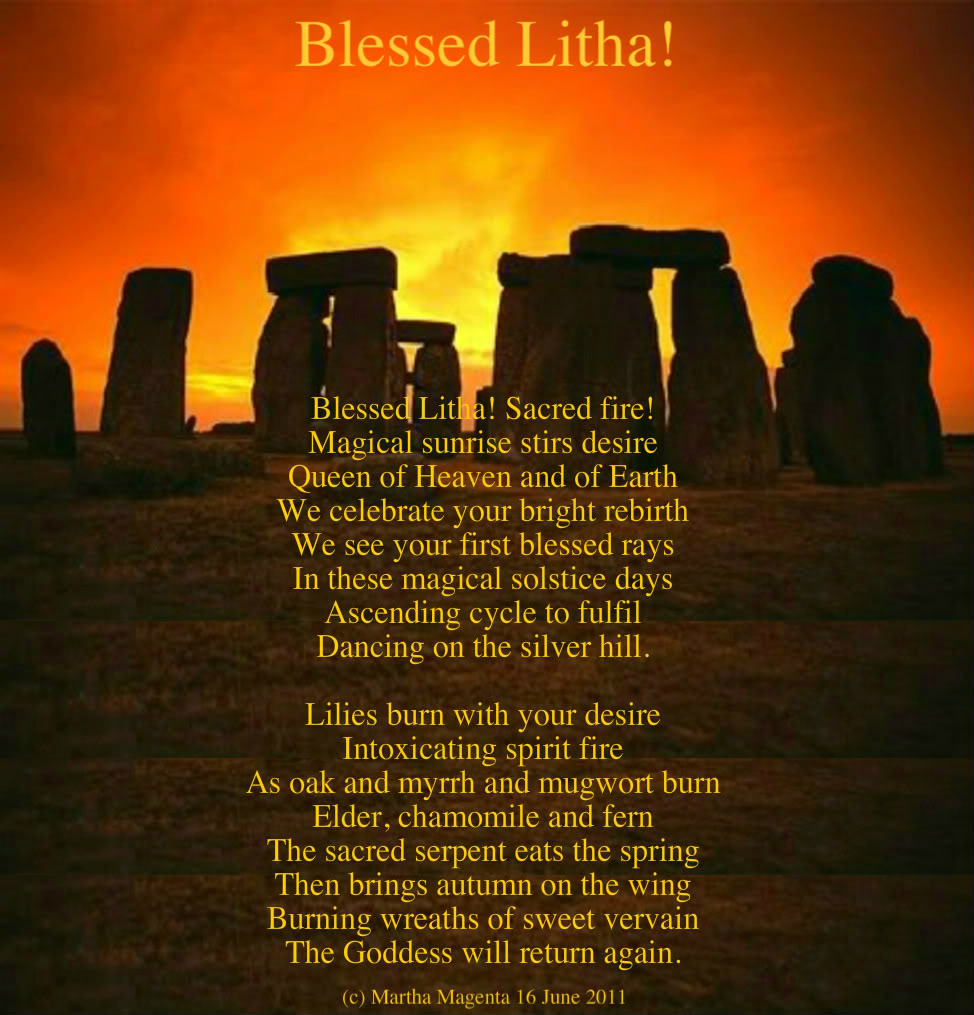
Litha poems and chants
Summer Solstice
by Rhiannon Cotter
Summer Solstice, the longest day,
represents a turning point from Spring to Summer
during which the Sun God directs the ripening
and blossoming of the grain and fruit.
Here in the heat of the Summer,
the crops are transformed as are our actions, thoughts and plans.
All things are tempered by the heat of the Sun.
Blossoming and ripening of our works are manifested,
or they shrivel and die in the heat. All the while, sexual energy is growing.
The Sun God impregnates the Earth Goddess in a sweet
“petit mort“–as the cup is to the Goddess, so too is the athame to the God.
Midsummer
by JT
Midsummer –
Longest day
Shortest night
Longest light
Shortest dark
The world within
Echoes the world without
Lush foliage, leaves unfurled
Soft springy grass dotted with
Brightly colored flowers peeping through
The earth is green and bright
With warm sunny days
Clear velvety blue skies
Gentle cool breezes
Nature in glory
Our hopes blossom
Creativity flowers
With the season
The seeds of the fruit
Our desires will bear
Can be seen
On the stems
Of our dreams
Summer Invocation
by Trish Telesco
Fireflies and summer sun
in circles round
we become as one.
Singing songs at magick’s hour
we bring the winds
and timeless powers.
Turning inward, hand in hand
we dance the hearth
to heal the land.
Standing silent, beneath the sky
we catch the fire
from out God’s eye.
Swaying breathless, beside the sea
we call the Goddess
so mote it be!
Litha Short History
Litha is the Wiccan Sabbat that marks the Summer Solstice and usually occurs around June
21. It marks the first day of summer on traditional calendars, but it is actually the Midsummer mark for Pagans.
Litha marks the longest day of the year, the day when the sun reaches its apex and is aspected to zero degrees Cancer. This is a day that celebrates the God in all his glory.
It is also the time of year when the Goddess is glowing with motherhood in her pregnancy.
In Wiccan lore, once again the Holly King and the Oak King battle. This time, it is the Holly King who is victorious, and from this point on, the days grow shorter.
For those of you familiar with Shakespeare, you might remember the play centered around the Solistice: “A Midsummer’s Night’s Dream“. It is believed that Midsummer Night’s Eve is a special time for those who believe in the Faerie traditions. Like Samhain, this is a day where the veils are thin between the realms of the Sidhe (the Faerie realm) and the world of mortals. It is a time for merriment and the making of wishes.
Litha marks the first of three harvest celebrations. This is the time to gather the herbs from your garden. Tradition suggests using your boline or a scythe to cut the plant by the moonlight. Some suggest chanting the use of the planet while doing so.
Honey is a popular symbol for this time (one of the names of the June Full Moon is the Honey Moon). Serving Meade as well as dipping your cake in honey during the feast part of your ritual, symbolizes the sweetness of life and the season.
As we’ve seen happen in the past, Christianity has tried to hone in on our holiday. They have declared it John the Baptist’s birthday. I’ve read that other Saints in the Church are remembered on the day they’ve died. But not so with John the Baptist. He is the only Saint recognized on his birthday. They celebrate the Solstice with the Jack–in–the–Green to the Feast of St. John the Baptist, often portraying him in rustic attire, sometimes with horns and cloven feet (like Pan).
Litha Long History
Litha, or Mid–Summer’s Day, falls on the Summer Solstice and is known as one of the ’quarter days’–Equinoxes and Solstices–that divides the year evenly into quarters. The Summer Solstice occurs when the sun reaches the Tropic of Cancer, hence this is the date the sun also enters the astrological sign of Cancer. For the northern hemisphere, this is when the planet is tilted to give us the most sunlight. Although this day is the longest of the year it is generally not the warmest. It is the day that the sun overpowers the darkness, and it is this source of energy that we use in our magic with themes of power and protection. The date of the Solstice varies from year to year, falling sometime between June 20th through 23rd. Old calendars marked time from sunset to sunset, so you may want to start your celebration on the eve of the Solstice which is after sunset on the day before the Solstice.
Litha is a celebration of the bounty of Summer. There are many flowers, with the bright pastel spring blooms giving way to the rich intensity of Summer flowers. The fields have been seeded, the plants are growing, some early crops may be harvested but most of all there is promise of the larger harvest to come in both the field and trees. Now we must trust that there will be enough rain and sun, and not too much of either or of the wind, so that we may harvest sufficient amounts to see us through the coming winter.
The youthful energy of spring and Beltane have mellowed into maturity; emotional maturity and love now matches the sexual maturity or lust of the earlier season. If Beltane was the lustful courtship of the Lord and Lady, this is Their wedding. Their passion is no less, but has increased in depth. Love is now their guiding force, and Lust is merely the spice .
This day is also known as Midsummer, because, for the pagan community, Summer officially starts at Beltane (on May 1) and ends on Lughnassahd (August 1) with this day falling in between the two. Other names that this holiday is known as are Litha and St. John the Baptist Day. For those who are of the Christian faith this the date chosen for honoring John the Baptist, cousin and fore–seer of Jesus Christ. The Christian church began doing after realizing how widespread and ingrained the festivals of this day were. St. John, the cousin of Jesus of Nazareth, was considered one of the most important saints, leading you to see the importance that the Christian church put in “claiming“ this holiday. Litha is a word supposed to derive from one that is Saxon denoting the opposite of Yule.
Traditionally, Litha is a time sacred to the Sun King, for this is when He is at His strongest. The God is in his prime. He has reached the peak of His power, and His rays are such that none dare look at Him for fear of being blinded by His light. With this power comes the heat of Summer, the promise of fruit and grain, and a great harvest to come. His potency ensures the continuity of life in the face of the oncoming darkness. He is ever–living, ever–returning with virility, fertility and strength. He guides us in our own personal growth, just as he guides the crops and creatures of Earth. His marriage with the Goddess now makes Him Her protector as well as her lover. He is a full grown man, and due to the merry making of Beltane, a father.
At Litha the God can be seen in many different traditions and mythologies. In the Oak King/Holly King myth, the Sun King has two separate personalities. These personalities are so strong that, to some, they become different entities, the Oak King and the Holly King, each ruling one half of the year. The Oak King was born at Yule to the Great Mother, and in his light and splendor begins to turn the Great Wheel and start the lengthening of the days. The beginning of the sun’s decline is symbolized by the return of the Holly King, the Spirit of Winter, at the moment after the Solstice. It is on mid–Summer that the dark half of the sun god begins to gain power. Often, mock battles are played between representatives of the two gods who fight over the attentions of the lady Goddess. At the Summer Solstice the dark Holly King (to some beliefs as the Wren) slays his light twin the Oak King (to some beliefs as the Robin) and begins his half–yearly reign which ends with the Holly King’s death at midwinter when the scene is reversed and the Oak King is triumphant. The eternal dueling of these light and dark brothers gives life to the primary tenant of western Goddess worship, “there is darkness in the light and light in the darkness.“ Although the Dark God is defeated, he has weakened the God of Light who has now begun to die. As everything in nature comes to its peak and then declines, so too must the God in His aspect of the Sun. With decline comes transformation, and so it is with the God, who takes on many aspects and wears many crowns.
The Earth Mother is also at Her finest at this time. The Goddess is becoming Mother, the seed that was planted earlier in her womb is growing with the son/sun. She blossoms just as the earth blossoms with abundance. She basks in the light of her lover and grows with child each day. The land is glowing with flowers and ripening fruit as the Goddess glows and ripens, as well. Like the animals and plants, we feed off of this warmth, and take a moment to rest on this Sabbat.
Once again, thinking back to our ancestors, we know that they found this to be a peaceful time. The crops were planted, their animals had usually birthed by this time and they had a slight lull as they awaited the time of the first harvest. Among humans there is change in the type of energy. Where spring made us sprightly, Summer makes us passionate. Flesh is revealed; sensuality is at its highest expression; heat makes us languid, yet the cooler nights are energizing.
Mid–Summer is said to be a mystical time when the forces of magic are increased and fairies roam our world. Fairies, elves and sprites are purported to be most easily seen at Mid–Summer, dancing in fairy rings. As portrayed in Shakespeare’s “A Mid–Summer Night’s Dream,“ it is a night much like Samhain, when the veils are once more thin between the realms of the Sidhe (or fae) and the world of mortals. This is the night when mortals have strange experiences, and when faeries troop across the land. Litha is a “day outside of time,“ and the strange experiences one might have are likely to be comic, harmless, or even beneficial. Litha has an “upside down“ quality about it – things are often reversed or mixed–up. It is a time for merriment and the wish making. There is a tradition of celebrating Litha where one makes wishes after gathering flowers(especially St. John’s Wort) either to hang in your home as protection amulets or to tied onto the tops of roofs as a symbol of a wish that you want carried into the next world.
The Sun festival was a noisy time, with singing, dancing, and drumming lasting the whole night through. In some places in Germany, tall fir–trees were set up in open places and decorated with flowers, and red and yellow eggs. The younger folk danced around these trees during the day, and the older ones during the evening.
Homes would frequently be decked with such plants as birch, white lilies, roses, and Saint John’s Wort. Saint John’s Wort was of particular importance to the Mid–Summer celebrations and in addition to wearing it and spreading it about the house, young girls would often use it to help divine the future of their love lives. Mistletoe, Mugwort, Vervain, Basil and many other herbs are harvested in ritualistic manners to preserve their energies for use in the colder times on Litha. Amulets of the past year are buried or burned and new ones, often for protection, are made for hanging around and outside the house.
Mugwort, in particular, was gathered on the mid–Summer’s eve, to be worn as head wreaths during the next day; these were then hung on the house or barn to act as protective charms for the ensuing year. To gather this herb today you would be barefoot, ideally, and cut the stems with an iron–free blade or “snip“ them by pinching with your fingers.
First ask permission of the mother plant, explaining why and how you will use the plant; then offer something in exchange. Custom says silver, but compost, fertilizer pellets or a special stone are also fine “payment“. Don’t let the herb touch the ground once it’s cut, but place it on a white cloth. Act quietly and with reverence.
As the days start to lose their light from this point, many cultures encouraged the Sun to return. Bonfires were representative of the Sun and they are still used on this day for that reason. Other sources of flame would include lanterns carried by revelers “walking the march,“ who were often attended by dancers and costumed players dressed as a variety of costumes. Flaming torches were carried around the fields and orchards to drive off insect infestations and other detriments to a good harvest. In Germanic countries smaller lanterns were set afloat on rivers and lakes as well. In other areas people would extinguish their home–fires, and then re–light them with a flaming torch or brand from the Mid–Summer fire.
In many cultures the bonfires were attended by all the villagers. Each person who attended would have contributed to its blaze. Besides adding light for the nighttime festivities, the fires where thought to ward off ill–meaning spirits and leaping of bonfires for purification, health, fertility, and love was common with the height of the leap thought to govern the eventual height of the crops in the fields. The bon fires are traditionally kindled from fir and oak with assorted herbs throne upon the flames. This was a time that might also entail the members of a village straddling brooms, pitchforks or other tools and jumping as high as they could to show the crops how high to grow while circling the bonfire or the fields themselves. In Germany, Mugwort and Vervain were tossed into the Mid–Summer fire upon leaving it, with the words, “May all my ill–luck depart and be burnt up with these.“ Herbs were also used by some peoples as a smudge, the smoke clearing bad influences from crops, animals, and people. Pigs and cattle would be driven between two fires to preserve their health and ensure their fertility or they might be driven through the fires to cure the sick and protect the sound. Afterward, some of the ashes from the herbs and charred wood of these huge fires would be taken to spread in the gardens among the cabbages. These ashes would keep the cabbage worm under control and it is not known if it was done for this purpose, alone, or if this was merely a beneficial “side effect.“
In Europe, it was a festival of lovers as well as that of fire. As each young unmarried couple leapt the flames, others speculated as to who would marry within the year. In other traditions lovers would leap fires together, or throw flowers to each other across the fire. Both flowers and fire were used to give omens for love and marriage. It is not surprising that roses, which bloom at this time, were used in many festivals and divination rituals, for their fragrance was said to be as sweet as love.
In many places sun–wheels were common on this holiday and that of Lughnasadh. They were wheels that were often rigged with straw and pitch, set aflame, and sent rolling down the hills toward a stream, pond or other body of water. Two young men would do their best to guide it, while one or more followed with torches to re–light the wheel should the fire die out. The longer the blaze, the better the harvest. A successful roll, extinguished in the watercourse, guaranteed an abundant harvest, as well.
Saint John the Baptist also has much importance in relation to this holiday. It was the custom in England, on St John’s Eve, to light large bonfires after sundown, providing light for the revelers and warding off evil spirits. There would be feasting and partying, dancing, games, bartering and all forms of celebration and, as in other areas, leaping the fire was a common practice. It should be noted , interestingly enough, that St. John, though a Christian figure, was seen by the early Celtic–Catholic people as a very pagan one. He was known as “the Oak King“ and had a strong connection to the nature in the wilderness . He was often depicted as a horned figure and, at times, with the lower portion of his body as a satyr, as though people regarded him as a Christian Pan.
This may seem very odd to a modern person, but keep in mind the fact that the early Christians, particularly those it the British Isles often simply put knew names to old deities. Modern day Christians celebrate mid–Summer is Saint John’s Day and celebrates his birth, much as Christmas celebrates the birth of Christ in coincidence with Yule. The reason given as to why Saint John’s birth is celebrated when every other Saint’s day occurs at death is that John is a special case since he was born exactly six months before Christ to announce the coming of the Messiah.
In ancient Rome, a “festival of jollity and drunkenness“ was celebrated by the Plebeians and slaves in honor of Fortuna, the Roman Goddess who was the personification of good fortune. She was originally a Goddess of blessing and fertility and in that capacity she was especially worshipped by mothers. Because she was considered the Goddess of Luck the word fortune comes from her name. At first, she was regarded as a kind of fertility Goddess or bearer of prosperity but, gradually, she was invoked exclusively for good luck–or lamented to for the lack of it! As the Goddess of Chance, she was consulted about the future at her oracular shrines in Antium and Praeneste (now Anzio and Palestrina). A favorite subject in ancient art, the Goddess Fortuna is usually depicted holding a rudder in one hand and a cornucopia, or horn of plenty, in the other. The rudder signified that she guides the destiny of the world; the cornucopia, that she was the provider of abundance. Known as Tyche to the Greeks, Fortuna was worshipped extensively throughout the Roman Empire and had oracular shrines at Antium and Praeneste (now Anzio and Palestrina). . The festival involved features of both fire and water. (The water link is noticeable in the Church’s choice of St. John the Baptist for this day.) Events included foot–races and boat–races, and plenty of wine and merry making. During the Middle Ages, she was depicted as Dame Fortuna who, spinning the wheel of fortune, seemingly at random, would grant goodness to one while she beset others with misfortune.
In nearly every culture, the Summer Solstice has been recognized, revered and even feared. The Sun is at its height, but at the same moment begins to decline. Only hope, ritual and belief would ensure its return at the Winter Solstice to our ancestors. Litha is a time for healing of all kinds, and protection rituals. This is a good time for clearing away non–useful energies, and establishing a stable base. Litha is about joy. It is about being completely alive, as the earth is at its zenith. Everywhere you look, it is green and life is abundant. Weave flowers into your hair – dance and frolic, take a big, deep cleansing breath of Summer air. Pick summer strawberries or other early fruits and vegetables. Know how fortunate you are to be a part of this wonderful circle of life and the turning wheel of the year.
Litha Recipes
Shakespeare’s Tea for a Midsummer’s Night
2 cups mint (peppermint or spearmint or 1 cup each)
1/2 cup marjoram
1/3 cup whole savory leaves
1/4 cup lavender flowers
Mix thoroughly and store in tightly covered container. To use, steep one teaspoon per cup of briskly boiling water for 10 minutes or so to taste.
Potato Crust Vegetable Pizza
4 medium baking potatoes, peeled
1 medium onion
2 beaten eggs
1/4 cup all–purpose flour
1 teaspoon salt
2 tablespoons olive oil
2 medium zucchini, thinly sliced
2 medium yellow summer squash, thinly sliced
1 medium yellow sweet pepper, chopped
1 small red onion, halved and thinly sliced
2 cloves garlic, minced
1 5.3–ounce package soft chevre (goat cheese)
16 cherry tomatoes, quartered
2 tablespoons snipped fresh basil
1 cup shredded mozzarella cheese (4 ounces)
Fresh basil sprigs (optional)
Finely shred potatoes and onion into a bowl of water; drain well, squeezing out excess moisture. In a large bowl combine potato mixture, eggs, flour, and salt; mix well. Press into a well–greased 15x10x1–inch baking pan. Bake in a 425 degree F. oven for 15 minutes. Brush with 1 tablespoon of the olive oil; bake 10 minutes more. Place under the broiler; broil 4 to 5 inches from the heat for 2 to 3 minutes or until golden and crisp.
Meanwhile, in a large bowl combine the zucchini, yellow squash, yellow pepper, red onion, and garlic. In a large skillet heat the remaining oil; cook the vegetable mixture, 2 cups at a time, until vegetables are crisp–tender, stirring often. Spread goat cheese over potato crust; top with cooked vegetables and tomatoes. Sprinkle with basil and mozzarella. Bake in a 425 degree F. oven for 5 to 7 minutes more or until cheese is melted. If desired, garnish with basil sprigs. Makes 8 to 10 servings.
Solar Tea
1 large jar with a very tight fitting lid
cold water
2 tea bags for each quart of water
1 orange, unpeeled, well washed, and cut into small pieces
1/2 lemon, unpeeled, well washed, and cut into small pieces
Fill the jar with water. Add the orange, the lemon, and the tea bags. Place in full sunlight for two hours. Refrigerate immediately. Serve over ice.
Cucumber Salad
1/2 cup sour cream
2 tablespoons chopped parsley
2 tablespoons white wine vinegar
1 tablespoon granulated sugar
1 tablespoon chopped chives
3 small cucumbers, thinly sliced
Combine the sour cream, parsley, vinegar, sugar, and chives.
Gently fold in cucumbers.
Cover and chill.
Sun’s Up Cobbler
1–1lb 14oz can (3 1/2 cups) halved peaches
3 slices slightly dry bread (toast on light)
1 tbs. cornstarch
1/4 cup butter or margarine, melted
1/4 tsp. salt
1/3 cup sugar
1 tbs. lemon juice
1/2 tsp. ground cinnamon
1/4 cup butter or margarine
1/4 tsp. ground nutmeg
Drain peaches, reserving 1 cup syrup. In a pan, combine cornstarch and salt and slowly blend in reserved syrup. Over med.–high heat, cook and stir until mixture comes to a boil. Reduce heat and cook and stir for 2minutes. Add lemon juice, butter or margarine and peaches. Heat JUST to bubbling. Pour into 10x6x11/2 inch baking dish.
Cut bread lengthwise into 1 inch strips. Dip into 1/4 cup melted butter, then into mixture of sugar, cinnamon, and nutmeg. Arrange over peaches. Bake at 375 degrees for 25 minutes or until toasty. Serve with cream (optional) Makes 6 servings.
Lunch Time Cranberry Sun Mold
2 –3oz packages orange flavored gelatin
2 7oz bottles ginger ale
1 1lb can whole cranberry sauce
2 oranges, peeled and sectioned
1 83/4 oz crushed pineapple, un–drained
1 grapefruit, peeled and sectioned
In saucepan, combine gelatin and cranberry sauce. Heat and stir until almost boiling. Stir in un–drained crushed pineapple and ginger ale. Remove from heat and stir until fizzing has stopped. Pour into round mold. Chill until set. Un–mold onto a serving dish with a layer of lettuce leaf bedding.
Garnish with orange and grapefruit sections. Top with alternating orange and grapefruit sections in a “pinwheel” array. Serve as salad or dessert.
High–In–The–Sky Sunny Sandwiches
4 French rolls
4 slices pressed ham
Butter or margarine, softened
4 slices salami
Several lettuce leafs
2 hard cooked eggs, sliced
4 ounces sharp cheddar cheese
French salad dressing
Split rolls lengthwise, cutting to but not through crust at back. Spread cut surfaces with butter or margarine. For each sandwich: Cover bottom half with a couple lettuce leafs, then slice cheese and cut lengthwise for julienne strips and add a few strips, fold slices of ham and salami and add. Place egg slices (3) atop folded meats. Drizzle approximately 1 tbs. of French salad dressing over each sandwich. Makes 4 servings.
Litha Activities and Ideas
Go berry picking. Have the children chose their best berry and throw it back into the berry bushes as they thank the Goddess and the bushes for the fruit.
Make a Wicker Man and burn him in your Litha bon fire.
Burn your remnants of your Yule Tree or Wreath in the bon fire or try using Wreaths of Vervain and Mugwort which were burned in ancient times at the end of the festivals to burn away bad luck.
Many families placed roses on the altar, as this is the Goddess flower for this time of the year. Try this yourself for a beautiful and fragrant decoration.
Leave out milk and honey as an offering to the Fae folk
Have a mock battle between the Oak and Holly King. Remember that this is part of the cycle and as the wheel turns the Holly King will rise again at Winter Solstice
Put a ring of flowers around your cauldron or around a bowl full of mugwort
Hang a bundle of fresh herbs out to dry and use them to spice up a Litha feast of cooked summer vegetables
Light a white candle and place it in front of a mirror. Say your own Litha prayer over it, and then let it burn out
Make a charm to hang around your neck with a seashell
Jump the balefire or cauldron
Offer a gift of lavender to the Gods in a bonfire. Pass St. John’s Wort through the smoke and then hang the herb up in the house for protection.
Make your own Stonehendge at the beach like you would a sand castle
Have an outdoor breakfast picnic to welcome the Solstice
Stay up and watch the sun go down on the longest day of the year!
Draw a picture of the sun at sunrise and sunset
Try a fire divination, stare into the coals of your bonfire as it settles or look for forms in the leaping flames.
Create a ritual to bring healing and love to Mother Earth
Dispose of those qualities that trouble you: project them into a burn–able (bunch of dry twigs, paper, etc.) and thrust the mass into a cleansing fire
make staffs
make dream pillows
make herb craft items like wreaths
make a witches’ ladder
Make a Catherine Wheel, or frame of sticks and withies (slender, flexible branches) with flammable material among the spokes. At the climax of your ritual, ignite the wheel and send it rolling down a hillside into a pond or lake. (obviously the hillside should be stone, bare earth, or covered with moist vegetation–no dry grass or underbrush!)
Litha Correspondences
Colors: gold, red, orange, blue, and yellow, green, white
Herbs & Plants: Apple, Chamomile, Chicory, Chickweed, Mugwort, Mistletoe, Heather, Peony, Pine, Roses, Vervain, Heartsease, Houseleek, Lavender, Rowan and Saint John’s Wort
Incense: Sage, Cedar, Frankincense, Lemon, Myrrh, Pine, Rose, and Lavender
Activities and Rituals: bonfire leaping, herb drying, protection, luck, health, transformation, community, career, and relationships
Tools: drums, rattles, bonfire, mirrors for reflecting the sun or bonfire, Earth circles of stone energy
Stones/Gems: all green stones, especially Emerald and Jade, Lapis, Diamond
Symbols & Decorations: flowers and fresh early garden produce, the spear or sword of the sun god and the bountiful cauldron of the goddess ringed in flowers, solar cross or sun symbols, fireworks, sea shells
Foods: all early summer fruits and vegetables, ale and mead, honey cakes, rose ice cream, melted cheese dishes, mangoes, whipped cream on fruit, red wine, strawberries
Deities: Fotuna, RA, Arinna, Bast, Grainne, Shamash, Helios, Mother Earth, Mother Nature Father Sun/Sky, Oak King
Animals: butterflies, caterpillars, sea creatures, wren, robin, horses, cattle, satyrs, faeries, firebird, dragon, thunderbird
Litha Ritual
Background
This is the time to rededicate yourself to your spiritual path and to ask for Lugh’s blessings. In this ritual marigolds are used to pay homage to the Lord. This flower has been associated with the sun since ancient times and abounds in stories of Apollo, the Greek sun god. Marigolds were believed to have magical properties, and that to look at them or smell their fragrance would remove sorrow and burdens.
The ancient people of Europe left their legacy in stone all over the Continent, the Mediterranean area, and the British Isles in the form of standing stone circles, alignments, and dolmens (chambers formed of standing stones). It has been known for a long time that these places mark the rising and setting of the sun at the Winter and Summer Solstices. They also mark lunar cycles, eclipses, and other astrological events.
It is worth noting that these sites were observatories as well as places of ritual. Science and spirituality were not separate compartments of reasoning and belief. Observing and honoring the natural world were integrated practices.
Stonehenge in England and Newgrange in Ireland are the most well–known sites, but the Brittany coast of France has the greatest number of standing stones. In this ritual, conjure up images in you mind and the energy of Carnac in Brittany where within a five–mile area there are 3,000 standing stones. Some are in circles, some are alone, but most are in rows that run for several kilometers. And for many centuries people danced and celebrated among the stones.
Setup
Items for this ritual include: Six candles for the altar; A basket of cut flowers; enough to lay out your circle (there can be space in between them); A basket of marigolds; Drums, rattles and other percussion instruments. If working solo or if these are not available you may want to use taped music such as Loreena McKennitt’s Huron “Beltane” Fire Dance; If doing ritual out of doors, find six to eight large rocks and set them in two rows with enough room for people to walk between to simulate the rows of standing stones at Carnac. If no large stones are available you may want to arrange a pile of smaller stones. If you are doing ritual indoors, use multiple baskets of flowers or potted plants. Be imaginative.
The Ritual
As you place flowers on the ground to mark your circle (large enough to encompass your “standing stones”) say:
Spring ends and summer comes upon the land. As the days grow in warmth, I ask the Lord and Lady to awaken the sacred flame within my soul. With this fragrant circle, sacred is this space decreed.
Go to the edge of your circle and face each direction, respectively. After speaking, light a candle on the altar. Face the altar when evoking the Goddess and God.
I look to the North and call on the powers of Earth to join me in my circle. Your body sends forth the blooms of early summer with rich sensuous colors. Be with me as a bright red flower.
I look to the East and call on the powers of Air to join me in my circle. Caress me with your warm breezes that sweeten my life with soft scented flowers and plants. Be with me as the fragrant Linden.
I look to the South and call on the powers of Fire to join me in my circle. Your growing heat transforms the world into a lush garden. Kiss me gently with your warmth.
I look to the West and the powers of Water. Your gentle rains banish thirst and wash me clean. Touch me with dew–filled mornings.
Sun King, Lord of Summer, I welcome you at your zenith, your last full shining. Tomorrow you begin your descent, but today I celebrate you.
Lady of All, Queen of Summer, I welcome you in your full mother aspect as the fields begin to ripen and you awaken a spark of divine love deep in my soul.
Stand facing your altar, and say:
This day I use marigolds to honor Lugh and ask for his blessing to further my spiritual journey.
Bow and then place a flower on the altar, saying:
Lugh, Beli Mawr, I thank you for your many blessings and reaffirm my spiritual path. Even though you will soon fade, your bright spirit will remain in my heart throughout the year. So mote it be.
Begin the taped music or do your own drumming and start a free–form dance weaving in and out among your “standing stones”. Chant:
I call to Lugh on Solstice Day,
Shine bright before you go away.
Sun King, Lugh, bring summer heat,
Blessed be and merry meet.
Continue until you feel the energy reach a peak, and then bring the music, drumming, chanting to a close. You may want to take time to meditate on your blessings as well as the reasons that you reaffirm your spiritual path.
Use your usual method for grounding energy or playback a recorded centering exercise.
Extinguish each altar candle before or after each devocation:
Lady of All, Queen of Summer, thank you Great Mother for the richness that unfolds around me and within me. I thank you for your presence with me this day and ask for your blessing as you depart. I bid you farewell.
Sun King, Lord of Summer, thank you for your bright spirit. I thank you for your presence with me this day and ask for your blessing as you depart. I bid you farewell.
Powers of Water, thank you for dewy mornings and gentle rains. I thank you for your presence with me this day and ask for your blessing as you depart. I bid you farewell.
Powers of Fire, thank you for your transforming flame. I thank you for your presence with me this day and ask for your blessing as you depart. I bid you farewell.
Powers of Air, thank you for warm breezes that sweeten long summer days. I thank you for your presence with me this day and ask for your blessing as you depart. I bid you farewell.
Powers of Earth, thank you for the sensuous colors and fragrance that enrich my life. I thank you for your presence with me this day and ask for your blessing as you depart. I bid you farewell.
And so my spiritual journey continues as the Wheel of the Year turns ever onward. My circle is open, but unbroken. May the peace and love of the Goddess remain in my heart. In faith and unity, blessed be.
Quick Palmistry
The Fingers
This area represents the mental element. If the fingers predominate, the subjects sphere has a mainly mental atmosphere.
The Upper Palm
This area represents the abstract element. If the middle portion of the hand is more pronounced, this would indicate the subject excels in ambition, shrewdness, and/or aggression tempered by prudence.
The Lower Palm
This area represents the material element. The development of the lower portion of the hand has a tendency to indicate a cultivation of not so nice motives, directed towards self–gratification and selfishness.
A hand with all three areas proportionate represents a bright and intelligent nature.
Seven Types of Hands
There are seven types of hands classified in Palmistry which relate to the general shapes. This is but a brief generalized overview.
The Elemental Hand
Often of the “clubbed” type with short thumb and stiff heavy fingers. To these hands belong war and colonization. Usually music lovers. Most are laborers.
The Square Hand
A square appearance as a whole including the palm and fingertips. Large thumb. This is the hand of practicality. Indications of a love of order, neat and tidy, courteous, patient and with an element of foresight.
The Spatulate Hand
The nail area of the hands give an appearance of a more or less flattened–out spatula. Usually large thumbs. Manual labor with a bit of love of adventure thrown in. Extremely self–confident, excellent leaders for a cause.
The Philosophic Hand
This hand has a large palm, the fingers are “knotty”. The top portion of the fingers have an oval egg–shape but appear flattened. When the hands are large, they incline toward analysis. They seek knowledge. The knotty fingers indicate a gift of calculation and deduction. Usually poetic in nature.
The Conic Hand
Also known as the Artistic Hand. Fingers are tapered, moderate sized palm, small thumb. Indicates he/she is impulsive, imaginative, a bit self–indulgent, and a lover of beauty.
The Psychic Hand
The most beautiful hand of all. Conical fingers, small, delicate, smooth and tapering. The upper phalanges are long. They tend to love beauty, are ethereal and imaginative. Poetic, enthusiastic but can also display a nervous tendency.
The Mixed Hand
Mixture of two or more types. A little of that one and a little of this one. The hand of versatality. “Jack of all trades”. Clever but has a tendency to be a bit erratic in his/her undertakings. Changing their minds constantly.
Major Lines
The Line of Life
The line of Vitality. Usually curving around the outer boundary of the Mount of Venus up towards the index (Jupiter) and middle (Saturn) fingers. Indicates constitution but also areas of major change in ones life.
The Line of Head
The line of Thought. Usually begins very near, with or above the Life Line at the base of the index finger (Jupiter). Indicates decision–making abilities, a strength of mental powers and concentration and your ability of thought processing. Can also show spine problems and upper thoracic pains.
The Line of Heart
Usually begins below your little finger (Mercury) through to the middle (Saturn) and index (Jupiter) fingers. Indicates both love (mentally) and condition (physical) of the heart. A h5 line shows mental and physical stability.
The Line of Fate
This line rises from the base of the hand up towards the middle (Saturn) finger. If this is deep, indicates perseverance against heavy odds. If it is a bit wavy, there will be ups and downs all through your life. If it goes all the way up to the Mount of Jupiter, success in everything you put your mind to.
The Line of Apollo
Also known as the Line of the Sun. This line runs up to the Mount of Apollo under the ring (Sun) finger. Indicates that with correct guidance and direction, you are capable of accomplishing much. A line of capability, possible accomplishments.
Purification Bath Before Ritual
Light incense and one taper candle. Place some sea salt in a white dish and water in a cup or vial (chalice). Make sure you’re not disturbed. No electrical lights, just light white candles. Pick up taper candle and make three passes over the water as you say:
By this element of fire, do I purify this ritual bath. May all impurities flee before its life.
Pick up salt and sprinkle 3 pinches of salt into bath water while saying:
By this element of earth do I purify this ritual bath. All impure creatures may not approach it.
Slowly pass the incense 3 times over the bath while saying:
By this element of air do I purify this ritual bath. May my hopes and aspirations rise upon the smoke to be carried by the winds to the Lady.
Pour the water into the bath next and say:
By this element of water do I purify this ritual bath. May the bath contain the waters of life that spring from the heart of the Mother.
Lay in the bath and let your troubles seep out of you and into the water. Dry off with a white towel and light clothing. Meditate if desired and apply any annointing oil.
Posted and Edited by Magickal Winds
Posted in Sabbats and tagged Chants, Litha, magick, Magickal Winds, magickalwinds.com, pagan, Poems, Recipes, Rituals, Summer Solstice, Wicca by admin with no comments yet.
SPIRIT ANIMALS AND POWER ANIMALS
SPIRIT ANIMALS AND POWER ANIMALS:

Posted by: Magickal Winds
Original contenet from: http://www.spiritanimal.info
What is the Difference Between a Spirit Animal and a Power Animal?
The terms “spirit animal” and “power animal” are often used interchangeably, even though they have slightly different meaning depending on the context in which they are used.
Spirit Animal Definition
Spirit animals are typically associated with traditional as well as modern Western shamanic practices. During initiations or shamanic journeys, the shaman would find one or several animals that she or another person is associated with. Traditionally, the spirit animal is used for guidance.
Think of your spirit animal as a guardian spirit or spirit guide. It can play the role of protector and provides guidance. It’s like a “personal guide or protector” that has a personal affinity with the person it’s associated with.
Power Animals
In addition, the spirit of the animal could unite with the person it “chose” in more personal ways and one will often find similarities in traits of personality, characteristics, and synchronicity between the two. As such, the power or essence of the animal can be felt or communicated. In that sense, spirit animals can also be referred to as “power animals”.
On this web site, the terms spirit animal, animal spirit guide and power animal are used interchangeably.
Connect With Your Spirit Animal
A spirit animal characterized by a personal relationship to the individual it is associated with. You can have one or several spirit animals throughout your life, during a specific phase of your life, or at specific occasions.
It is that connection at the individual level that differentiates the power animal from the animal totem that tends to symbolize a group or person’s identity. As such, power animals are the equivalent of animal spirit guides or spirit animals.
Your spirit animal often represents qualities and attributes that you may see in yourself. It is instructive to learn about the habits and characteristics of your power animal and see how they are reflected in your own personality and life.
How To Find Your Spirit Animal
There are many different ways to find your spirit animal:
- Meditation
- Going in nature and observing
- Calling the animal
- Process of self-inquiry
- Writing about it in your journal
- Imagination
- Journeying with sound
These are a few methods among many used to find the animal or animals you have a special connection with. >> Learn more on how to find your spirit animal.
When developing a meaningful relationship with your spirit animal, prepare yourself to explore a world where you can rely more on your imagination and intuition, rather than only using your intellectual abilities and rational mind.
When developing a meaningful relationship with your spirit animal, prepare yourself to explore a world where you can rely more on your imagination and intuition, rather than only using your intellectual abilities and rational mind.
Spirit Animal Symbolism
Animals are omnipresent in our lives whether they are pets or live in the wild, yet we often lack a clear understanding of their symbolic nature and what they could mean. When we relate to the spirit of animals, they may offer us powerful insight.
In the world of spirit animals, animals can symbolize:
- Aspects of your personality
- Skills or traits that we have cultivated successfully or have yet to develop
- A situation or emotions that have recently arisen
- Spirit animals can also offer guidance, an intuitive understanding
Search the list above for more information.
Spirit Animal Meanings
Looking for A Spirit Animal?



Posted in Animals and tagged magick, Magickal Winds, pagan, Power Animal, Spirit Animal, Spirituality, Wicca by admin with no comments yet.
The Symbolic Meaning of the Pentagram and Pentacle
Symbolic meaning of the Pentagram and Pentacle
Posted by: Magickal Winds
The Pentagram:
The Pentacle:

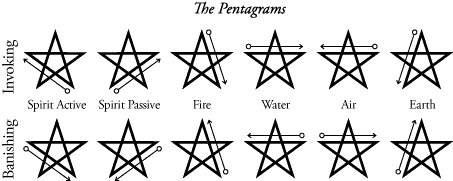
The Pentagram is a symbol of a star encased in a circle. Always with 5 points (one pointing upward), each has its own meaning. The upward point of the star is representative of the spirit. The other four points all represent an element; earth, air, fire, and water. All these things contribute to life and are a part of each of us.
To wear a pentagram necklace or other form of jewelry, is to say you feel the connection with the elements and respect the earth.
The number 5
The number 5 has always been regarded as mystical and magical, yet essentially ‘human’. We have five fingers/toes on each limb extremity.We commonly note five senses – sight, hearing, smell, touch and taste. We perceive five stages or initiations in our lives – eg. birth, adolescence, coitus, parenthood and death. (There are other numbers / initiations / stages / attributions).
The number 5 is associated with Mars. It signifies severity, conflict and harmony through conflict. In Christianity, five were the wounds of Christ on the cross. There are five pillars of the Muslim faith and five daily times of prayer.
Five were the virtues of the medieval knight – generosity, courtesy, chastity, chivalry and piety as symbolised in the pentagram device of Sir Gawain. The Wiccan Kiss is Fivefold – feet, knees, womb, breasts, lips – Blessed be.
The number 5 is prime. The simplest star – the pentagram – requires five lines to draw and it is unicursal; it is a continuous loop.
Human stars
Expressing the saying Every man and every woman is a star, we can juxtapose Man on a pentagram with head and four limbs at the points and the genitalia exactly central. This is Man in microcosm, symbolising our place in the Macrocosm or universe and the Hermetic / Tantric philosophy of associativity as above, so below.
The Golden Proportion
The geometric proportions of the regular pentagram are those of the Golden Section. The Golden Proportion is one beloved of artists since Renaissance times and also to be found in post-Hellenic art and in the geomantic planning of Templar sites, being those proportions of a rectangle considered most pleasing to the eye. Here, the ratio of the lengths of the two sides is equal to the ratio of the longer side to the sum of the two sides. Or :
a/b = b/a+b = a+b/a+2b = a+2b/2a+3b = 2a+3b/3a+5b ….etc.
If a square is added to the long side of a golden rectangle, a larger golden rectangle is formed. Continuing this progression forms the basis for a nautilus spiral. The ratio of the distance between two points of a pentagram to its total width is in the golden proportion, as is the ratio of the height above the horizontal bar to that below, as is the ratio of a central part of a line to the outer part.
This ratio forms the foundation of the Fibonacci series of numbers 1, 1, 2, 3, 5, 8, 13, 21, 34, 55, 89, 144, etc. where each number is formed by adding the previous two numbers. The Fibonacci series is much found in nature in the pattern arrangement of flower heads and leaves and many flower heads and fruits themselves exhibit a fivefold symmetry.
Protection against evil
The pentagram has long been believed to be a potent protection against evil, a symbol of conflict that shields the wearer and the home. The pentagram has five spiked wards and a womb shaped defensive, protective pentagon at the centre.
Five elements
Here are five elements, four of matter (earth, air, fire and water) and THE quintessential – spirit. These may be arrayed around the pentagrams points. The word quintessential derives from this fifth element – the spirit. Tracing a path around the pentagram, the elements are placed in order of density – spirit (or aether). fire, air, water, earth. Earth and fire are basal, fixed; air and water are free, flowing.
The single point upwards signifies the spirit ruling matter (mind ruling limbs); is a symbol of rightness. With two points up and one (spirit) downwards, subservient, the emphasis is on the carnal nature of Man.
Drawing a Pentagram
These point attributions are used in ritually inscribing, as a flourish of the hands or the athame, different forms of pentagram for invoking or banishing (grounding) each of the elementals according to the nature of the ritual. The line traces as illustrated for earth (the last stroke is optional).
Another way of seeing this path is as Man’s spiritual journey through evolution. The spark of Life descending from God, the divine source of life to the simplest embryonic form (earth), rising to flow (water – air) on our plane of existence (compare with the intonation of the AUM mantra), then again descending to the fire of purification before again rising as a divine spark to find again his spiritual source.
The pentagram may be shown as an interlaced line symbolic of the web-weaving power of magick. The descending spirit-earth line may pass under (male) or over (female) the water-air line to give two slightly differing forms.
Open Pentagram
A pentagram may be open, without a surrounding circle.This is the active form symbolising an outgoing of oneself, prepared for conflict, aware, active. (One wearing an open pentagram must be physically aware of the danger of sharp points sticking in their skin from time to time). As a pagan religious symbol, the open pentagram represents an open, active approach.
Circled Pentagram (Which I call a PENTACLE, not a Pentagram)
A circle around a pentagram contains and protects. The circle symbolises eternity and infinity, the cycles of life and nature. The circle touching all 5 points indicates that the spirit, earth, air, water and fire are all connected.
The circled pentagram is the passive form implying spiritual containment of the magic circle, in keeping with the traditional secrecy of witchcraft, and the personal, individual nature of the pagan religious path, of its non-proselytising character.
Inverted Pentagram
Although some 2nd Degree High Priests and Priestesses wear their PENTACLE (not Pentagram) inverted, that is to symbolize their 3rd degree status not the same meaning as an inverted Pentagram. The pentagram may be inverted with one point down. The implication is of spirit subservient to matter, of man subservient to his carnal desires. The inverted pentagram has come to be seen by many pagans as representing the dark side and it is abhorred as an evil symbol. Fundamental christians, indeed, see any form of pentagram as such. However, these are recent developments and the inverted pentagram is the symbol of Gardnerian second degree initiation, representing the need of the witch to learn to face the darkness within so that it may not later rise up to take control. The centre of a pentagram implies a sixth formative element – love/will which controls from within, ruling matter and spirit by Will and the controlled magickal direction of sexual energies. This is another lesson of initiation.
The Pentagram As A Christian Symbol
Up until medieval times, the five points of the pentagram represented the five wounds of Christ on the Cross. It was a symbol of Christ the Saviour. This is in stark contrast to today where the pentagram is criticized by modern Fundamentalist Christians, as being a symbol of evil.
The church eventually chose the cross as a more significant symbol for Christianity, and the use of the pentagram as a Christian symbol gradually ceased.
Posted by: Magickal Winds
Posted in Uncategorized and tagged Magickal Winds, pagan, Pentacle, Pentagram, Religion, Spirituality, Wicca by admin with no comments yet.
There is no more simple Magickal charm in the universe than… “Blessed Be.”
Posted by Magickal Winds
Author: Ariel
Probably the most common phrase that we use in the Craft is “Blessed Be.” This phrase is possibly the major common denominator in all of the different Craft traditions.
It is something that is a unifying principle within Witchcraft and although it is the most often articulated saying we have, it seems to me to be the least understood one I know of.
When we say “Blessed Be, ” all too often it is simply new jargon, or a substitute for “Hi, ” “How are you?” or “Good Bye.” Yet, these two words comprise one of the most powerful and sophisticated sentences in the English language.
“Blessed Be” is an ultimate Zen phrase, “Blessed be that which is”; “All that is, is blessed”. We are recognizing a truth that all is inherently blessed. We are reminded that in the present moment, everything is perfect. There is nothing that needs to be changed, and nothing that needs to be improved.
In this moment, everything is sacred. Being at one with the sacred now is a blessed state indeed, and saying “blessed be” from that point of view is a potent statement of recognition of the perfection of this moment. There is no future to obsess about, and no past to regret.
There is only this moment; it goes on forever, and all is truly blessed.
Another important facet of this gem of a saying is that it is a constant reminder of our function in the Craft: We are here to bless.
Once we develop a significant relationship with Spirit, in whatever way it presents itself to us, we eventually come to recognize that what the world needs from us is our blessing. The only significant contribution we have to offer the world is blessing.
In any situation, with any person or group of people, we are here to say (and mean) “Blessed Be, ” either silently or aloud.
When we take an honest look at any problem in the world, it becomes apparent that the problem stems from a lack of blessing, and the only cure is to bless.
I know for myself, I can honestly say that anytime I have been less than loving or compassionate in my life, it was in response to a great deal of pain I was experiencing at the time.
What I didn’t need in order to turn my life around was more judgment, anger and criticism. What I needed was love and blessing.
I needed someone to say “Blessed Be” and mean it.
We are children of divinity–children of the Mother and Father, of Spirit, of God, or whatever you choose to call it. As divine children, we are here as expressions of our parents. We are here as lights in a dark world. Our function is to recognize the light and divinity in everyone else.
“Blessed Be” can also be another way of saying “The divine love in me recognizes the divine love in you”. We are here as healers of this world. Whether we take this job seriously or not will determine what direction our world takes.
We have the power to transform the world in every moment just by seeing any situation from the point of view that we are divine beings here to bring blessing.
It isn’t a question of whether or not we have the power to bless, it is a question of whether we choose to use it or not.
If we say “Blessed Be” consistently and mean it, this planet can heal very quickly.
One thing that I have learned in my life is that there is enough pain in this world. We all know what pain is. We have been to hell already; we don’t need to indulge in pain any longer in order to know we want something else.
I can honestly look at my life and say that what I really need is not more misery. I see that what many of us are doing is indulge in misery out of habit, or addiction. It takes a great deal of determination to understand that our addictions are not serving us any longer and then decide that we are going to relinquish our investment in them.
Unfortunately, like any addiction, we often wait until we hit rock bottom before we realize that we have a problem. In Alcoholics Anonymous, the first step to sobriety is for the alcoholic to recognize that they are powerless over alcohol, and that there is a higher power who can restore them to sanity.
This is what blessing is all about. Whatever our wound, the healing comes about from blessing.
If we have a strained relationship with another person, our greatest work to bring us happiness in that relationship is the honest blessing of that person.
If we have a problem with our job, the healing comes about from blessing the job, and all the people in it on every level.
The act of blessing that I describe is not an abdication of power; it is a reclaiming of power.
Some might worry that we need to protect and need to defend ourselves, and that if we are blessing all the time, it will just leave us vulnerable to attack. This worry comes from the erroneous point of view that Spirit is ineffectual. We would do well to remember that the power of love is fierce.
Spirit is intelligent. It knows what to do. When we bless the world, we are in a position of ultimate power. Just as when our physical immune system is healthy, it takes care of all the viral and bacterial activity without us needing to know what is happening.
The Craft of blessing results in building a spiritual immune system that is so strong that nothing can touch us. It is not necessary for us to carry out punishment (curses) on others in order to be safe and protected. In fact, cursing is a domain in which we leave ourselves the most open and vulnerable to attack.
Cursing is very subtle stuff. Curses aren’t necessarily consciously cast. Anytime we desire the pain and destruction of another person for any reason, we are withholding our blessing, and are by default cursing.
Resentments and grudges do come up however, and I am not suggesting that we are supposed to just suppress our feelings and pretend like we are not feeling rage when we are feeling it.
What I am suggesting however is that when we are feeling anything other than love for people that we recognize it and bring it to Spirit to heal.
This is the ultimate magic: transformation.
When we are feeling anger toward another person, we can say “Goddess, I am really pissed of at so-and-so, and want to crush their big fat head right now. Please heal this situation. Please bring me back in harmony with your compassion. Show me what I need to do in this situation, let me know what to say in order that this situation be healed.”
We aren’t denying our rage, but we are embracing our ability to move beyond it. A curse is when the rage and desire to destroy are kept within us to fester.
Curses are psychic malignancies.
Blessing is a silent art. Just because we bless someone doesn’t mean we have to have lunch with him or her.
Blessing is not about forcing our personal wills on any situation. It is simply recognizing the people and situation before us as divine, and seeing the love at the heart of whatever is going on regardless of the drama that is being played out.
We simply access the Spirit within us and ask for its will to be done in our presence. We withdraw our preconceived notions of what is supposed to happen, or what we think we want to have happen, and allow ourselves to invoke the presence of pure love.
When we are facing a problem, and we think we have tried everything, it is very important that we ask ourselves whether or not we have given our blessing. Often this is something that we have overlooked.
I can’t count the number of times I have been in the throes of misery and the one thing I have NOT tried is asking Spirit directly to take the problem and heal it for me. Once we renounce our addiction in the pain, we are transformed.
We have shifted our plane of experience from one of cursing, to one of blessing.
There is no more simple, or more powerful magical charm in the universe than “Blessed Be.”
Posted by Magickal Winds
Posted in Origins and tagged Blessed Be, Blessings, Charms, magick, Magickal Winds, pagan, spells, Spirituality, Wicca, wiccan by admin with 1 comment.
Yule and the Winter Solstice
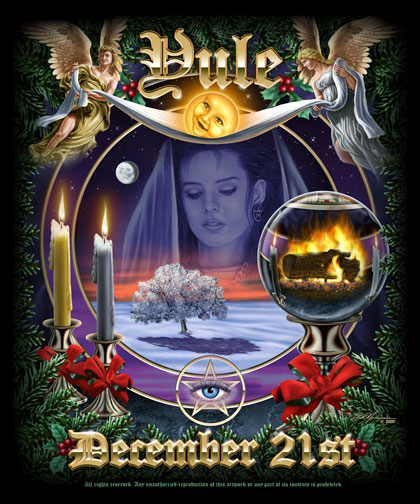
Below is a variety of Yule history, traditions, symbols and lore for your information and entertainment. Enjoy.
These are not necessarily Magickal Winds’ views; we like to share research with the public; this does not mean we agree with everything we research and post.
Posted by Magickal Winds
Yule Lore
(December 21st)
Yule, (pronounced EWE-elle) is when the dark half of the year relinquishes to the light half. Starting the next morning at sunrise, the sun climbs just a little higher and stays a little longer in the sky each day. Known as Solstice Night, or the longest night of the year, much celebration was to be had as the ancestors awaited the rebirth of the Oak King, the Sun King, the Giver of Life that warmed the frozen Earth and made her to bear forth from seeds protected through the fall and winter in her womb. Bonfires were lit in the fields, and crops and trees were “wassailed” with toasts of spiced cider.
Children were escorted from house to house with gifts of clove spiked apples and oranges which were laid in baskets of evergreen boughs and wheat stalks dusted with flour. The apples and oranges represented the sun, the boughs were symbolic of immortality, the wheat stalks portrayed the harvest, and the flour was accomplishment of triumph, light, and life. Holly, mistletoe, and ivy not only decorated the outside, but also the inside of homes. It was to extend invitation to Nature Sprites to come and join the celebration. A sprig of Holly was kept near the door all year long as a constant invitation for good fortune to pay visit to the residents.
The ceremonial Yule log was the highlight of the festival. In accordance to tradition, the log must either have been harvested from the householder’s land, or given as a gift… it must never have been bought. Once dragged into the house and placed in the fireplace it was decorated in seasonal greenery, doused with cider or ale, and dusted with flour before set ablaze be a piece of last years log, (held onto for just this purpose). The log would burn throughout the night, then smolder for 12 days after before being ceremonially put out. Ash is the traditional wood of the Yule log. It is the sacred world tree of the Teutons, known as Yggdrasil. An herb of the Sun, Ash brings light into the hearth at the Solstice.
A different type of Yule log, and perhaps one more suitable for modern practitioners would be the type that is used as a base to hold three candles.
Find a smaller branch of oak or pine, and flatten one side so it sets upright. Drill three holes in the top side to hold red, green, and white (season), green, gold, and black (the Sun God), or white, red, and black (the Great Goddess). Continue to decorate with greenery, red and gold bows, rosebuds, cloves, and dust with flour.
Deities of Yule are all Newborn Gods, Sun Gods, Mother Goddesses, and Triple Goddesses. The best known would be the Dagda, and Brighid, the daughter of the Dagda. Brighid taught the smiths the arts of fire tending and the secrets of metal work. Brighid’s flame, like the flame of the new light, pierces the darkness of the spirit and mind, while the Dagda’s cauldron assures that Nature will always provide for all the children.
Symbolism of Yule: Rebirth of the Sun, The longest night of the year, The Winter Solstice, Introspect, Planning for the Future.
Symbols of Yule: Yule log, or small Yule log with 3 candles, evergreen boughs or wreaths, holly, mistletoe hung in doorways, gold pillar candles, baskets of clove studded fruit, a simmering pot of wassail, poinsettias, christmas cactus.
Herbs of Yule: bayberry, blessed thistle, evergreen, frankincense holly, laurel, mistletoe, oak, pine, sage, yellow cedar.
Foods of Yule: cookies and caraway cakes soaked in cider, fruits, nuts, pork dishes, turkey, eggnog, ginger tea, spiced cider, wassail, or lamb’s wool (ale, sugar, nutmeg, roasted apples).
Incense of Yule: Pine, cedar, bayberry, cinnamon.
Colors of Yule: red, green, gold, white, silver, yellow, orange.
Stones of Yule: rubies, bloodstones, garnets, emeralds, diamonds.
Activities of Yule: caroling, wassailing the trees, burning the Yule log, decorating the Yule tree, exchanging of presents, kissing under the mistletoe, honoring Kriss Kringle the Germanic Pagan God of Yule
Spellworkings of Yule: peace, harmony, love, and increased happiness.
Deities of Yule: Goddesses-Brighid, Isis, Demeter, Gaea, Diana, The Great Mother. Gods-Apollo, Ra, Odin, Lugh, The Oak King, The Horned One, The Green Man, The Divine Child, Mabon.
—Adapted by Akasha Ap Emrys
For all her friends and those of like mind
Yule Traditions and History
Yule is the Anglo-Saxon word for the festival of the Winter Solstice. It comes from the original ‘Iul’ meaning ‘wheel’. In the old Almanacs, the symbol of a wheel was used to mark Yuletide. The idea behind this is that the year turns like a wheel, The Great Wheel of the Zodiac, The Wheel of Life, of which the spokes are the old ritual occasions. The winter solstice, the rebirth of the Sun, is a particularly important turning point.
According to the Bardic Tradition, the winter solstice was called ‘Alban Arthan’ by the Druids. It was then that the Chief Druid cut the sacred mistletoe from the Oak, a custom that still lingers with our use of mistletoe for Christmas decoration. It is interesting to note that Mistletoe is usually banned from churches at Christmas, because of it’s Pagan association. However, at one time, there used to be a different tradition at York Minister. Stukeley, an eighteenth-century writer noted that on Christmas Eve, they carried Mistletoe to the High Altar in the church and proclaimed a universal liberty and pardon to all sorts of criminals and wrongdoers.
The idea of holding a festival at the winter solstice, to celebrate the rebirth of the Sun was so universal in the ancient world, that the Christians adapted it. No one really knows for sure when Christ was born, but by holding this feast at midwinter, Christ was mystically identified with the Sun. The Romans celebrated the winter solstice with a festival called Saturnalia. The winter solstice takes place when the Sun enters the Sign of Capricorn, and Saturn, the ruler of Capricorn, was also supposed to be the ruler of the far off Golden age of the past when the world was happy and fruitful. At this time of the year, the Romans decked their houses with boughs of evergreen trees and bushes. People gave each other presents, and all normal business was suspended and social distinctions were forgotten. Servants and slaves were given a feast by their masters who waited the tables.
The Pagan Saxons celebrated the feast of Yule with plenty of ale and blazing fires, of which our Yule log is the last relic. The Yule log is actually an indoor equivalent of the outdoor bonfire of Midwinter Eve. There used to be an old custom of saving a piece of the Yule log, ‘for luck’ to kindle the next year’s blaze.
The evergreens for Yuletide decorations were holly, ivy, mistletoe, bay, rosemary, and the green branches of the box tree. By Candlemas, all these had to be gathered up and burnt, or hobgoblins would haunt the house. In other words, by the time a new tide of life had started to flow, people had to get rid of the past and look to the future. Spring-cleaning was originally a nature ritual.
Yule marks the death and re-birth of the Sun God. It also marks the vanquishing of the Holly King, God of the waning year, by the Oak King, God of the waxing year. Old mumming plays, which still exist in some places as part of the Yuletide festivities, are linked with the rebirth of the Sun. Saint George in shining armor, comes to do battle with the dark faced ‘Turkish Knight’. Saint George is the Sun, slaying the powers of darkness. However, the victor immediately proclaims that he has slain his brother. Dark and Light, winter and summer are complementary to each other. So on comes the mysterious ‘Doctor’ with his magical bottle who revives the slain man. There is much rejoicing and all ends well. Another version of the Oak/Holly King theme, is the ritual hunting and killing of a Wren. The Wren, little King of the Waning Year, is killed by the Robin Redbreast, King of the Waxing Year. The Robin finds the Wren hiding in an Ivy bush (or as in some parts of Ireland – a holly bush).
At Yule, the Goddess shows her Life-in-Death aspect. At this season, she is the leprous-white lady, Queen of the cold darkness, yet, this is her moment of giving birth to the child of Promise, the Son-Lover who will refertilize her and bring back light and warmth to her kingdom.
The Winter Solstice rebirth and the Goddess’s part in it, were portrayed in ancient Egyptby a ritual in which Isis circled the shrine of Osiris seven times, to represent her mourning for him and her wanderings in search of the scattered parts of his body. For the festival, people decorated the outside of their houses with oil-lamps that burned all night. At midnight, the priests emerged from an inner shrine crying, “The Virgin has brought forth! The light is waxing!” and showed the image of a baby to the worshippers.
Lamps burning all night at Midwinter, survive in Ireland and elsewhere, as the single candle burning in the window at Christmas Eve, lit by the youngest in the house – a symbol of mircocosmic welcome to the Marcosm.
Whatever the form or name of Yuletide celebration, it is a festive time of year throughout the world. With the rebirth of the Sun, the giver of warmth, life and light, people had something to be genuinely happy about.
* Researched from various sources by The Silver Circle
Winter Solstice
Lisa Hutchins, 1997
The winter solstice takes place on or about December 21 every year, and is the moment when the sun is at its southernmost position. For those in the northern hemisphere, this means that on the winter solstice the sun rises the latest and sets the earliest of the entire year. It hangs low and weak in the sky during the brief daylight hours, and daytime shadows are the longest. Because the day is the year’s shortest, the winter solstice is also the time of the longest night.
Ancestral Celebrations
Solstice rites are one of our oldest celebrations, dating back to the dawn of modern civilization some 30,000 years ago. For ancient peoples, the winter solstice was an awesome, mysterious, and powerful phenomenon.
Those of us today who have ever pondered the ramifications of a cataclysmic event such as a “nuclear winter” or the aftermath of a giant meteor impact can understand how frightening it must have been to see the sun slip away every fall. Harsh winter conditions and scare food supplies made survival risky. Vegetation was dormant, migratory birds had long since disappeared to warmer climes, and many animals had vanished into hibernation. As the weeks drew closer to the solstice, it was a time of anxiety over ever-darkening days. What if the sun lost its vigor and never came back? Would light and warmth simply fade away forever? Would the earth be wrapped in eternal night and cold?
Early peoples, living at the mercy of a hostile environment- and also highly sensitive to natural phenomena-held supplicating rites to the forces of nature as a way of ensuring the return of longer, warmer days. To early cultures, the winter solstice represented the death of the old solar year and the birth of the new. Yule festivities, accordingly, marked this planetary turning point away from darkness and the blessed return to light. And although the comforts of today’s modern civilization now shield us from winter’s harsh effects, Western cultures continue-knowingly or unknowingly-to honor this tradition through Yule celebrations.
Interestingly, Christmas (and its attendant holiday, Easter) actually have roots in ancient beliefs going back tens of thousands of years. Many folk holidays and celebrations were absorbed into Christian culture in the early days of Christianity to make the new religion more acceptable. There was no consensus among early Church fathers over the date to use for Christ’s birth. (In fact, as devout Christians know, there is no certain date for the birth of Christ. Current estimates based on historical and astronomical records put it at around February 6, 6 B.C.) A December festival to celebrate the birth of Christ didn’t exist until the fourth century when Christians simply adopted the popular Yule celebrations for their own use. Roman churchmen favored the Mithraic winter solstice festival, which they themselves had adopted from the Persians called the Birthday of the Unconquered Sun. On the old Roman calendar, December 25 (not December 21) was the date of the winter solstice. The winter solstice was also the traditional date to honor the birth of the pagan Divine Child, and Norsemen celebrated the birthday of their lord, Frey, at the winter solstice. After much argument, Pope Julius selected December 25 as Christ’s Mass, or Christmas, in 350 A.D.-in part to counter persistent pagan solstice rites, but also because people of the time were already used to calling it a god’s birthday. (This proclamation was not without objection, however. The date was so controversial that eastern churches refused to honor it for another hundred years, and the church of Jerusalemignored the date until the 7th century. And in an interesting twist, the fifth-century Bishop of Constantinople firmly believed December 25 was selected so Christians could celebrate Christ’s birthday undisturbed while “the heathen were busy with their profane ceremonies”!)
Even today, pagan and Christian belief is intermingled with Christmas celebration. Many traditions that are now a part of the mainstream Christian culture actually come from ancient pagan celebrations-rites such as decorating with evergreens, hanging ornaments on a tree, partaking of sweet confections, processions, gift giving, wassailing or singing carols, and the burning of the yule log.
Solstice Traditions
Winter solstice observances were held by virtually every culture in the world. Solstice rites were practiced among such diverse groups as Native South Americans, Celts, Persians, Orientals, and Africans. Solstice was known as Sacaea to the Mesopotamians, as the Festival of Kronos to the ancient Greeks, and as Saturnalia to the Romans. According to Norse traditions, the Valkyrie looked for souls to bring to Valhalla during Yule. Norwegians abstained from hunting or fishing for the twelve days during Yule as a way of letting the weary world rest and to hasten the revived sun’s appearance. In old Russiait was traditional to toss grain upon the doorways where carolers visited as a way of keeping the house from want throughout the rest of the winter. Ashes from the Yule log were mixed with cows’ feed in France and Germany to promote the animals’ health and help them calve. In Baltic regions today, corn is scattered near the door of the house for sustenance and ashes of the Yule log are given to fruit trees to increase their yield. Romanians bless the trees of the orchard on Yule with sweetened dough to bring good harvests. Serbs toss wheat on the burning Yule log to increase livestock bounty.
The most significant Yule tradition to persist over the centuries is the Christmas tree. Although the origin of the Christmas tree is generally ascribed to Martin Luther, its beginnings actually go back to pre-Christian times. Christmas trees are thought to have evolved from the rite of symbolically selecting and harvesting a “sacred tree,” a practice found in many ancient cultures. Evergreens and firs were sacred to early peoples, including the ancient Greeks, Celts, and Germans. The first Yule trees were born when pagans went into the forests during the winter solstice to give offerings to evergreens. Pines and firs remained green while other vegetation lost their leaves and appeared lifeless during the bitter winter cold. Their mysterious survival and vigor seemed to signify a life force within which carried with it the hope of renewed life.
The pinea silva or sacred pine groves that were attached to pagan Roman temples also pre-figured the Christmas tree. On the night before a holy day, Roman priests called “tree-bearers” cut one of the sacred pines, decorated it, and carried it into the temple. In fact, the German word for Christmas tree is not Kristenbaum, or Christmas tree, but Tannenbaum, or sacred tree.
Church leaders from the early centuries of the Church all the way through Puritan society in 17th century Massachusettscondemned the custom of bringing decorated evergreens into the home at Yule time. The custom was so beloved and persistent, however, that repeated attempts to eradicate ‘heathen’ practices ultimately failed-and now these pagan traditions, which largely celebrate nature, are among the most treasured elements of the season.
Decorating the tree with objects resembling fruits, nuts, berries, and even flowers is thought to be a symbolic act designed to bring about the return of summer’s bounty. In this way early cultures hoped to hurry the return of spring, and ensure survival through the rest of the harsh winter months.
Christmas wreaths are also ancient, and were traditionally made of evergreens, holly, and ivy. The wreath’s circle symbolizes the wheel of the year and the completion of another cycle. Holly represents the female element; ivy represents the male. Like evergreens, holly was believed to contain a mysterious life force because it bore berries in the middle of winter. Both holly and ivy were thought to have magical properties, and were used as protection against negative elements.
Kissing under the mistletoe is an old Druid tradition. Mistletoe was considered highly sacred by this culture because, as a parasitic kind of vegetation, it never touched the earth (growing instead on oaks and other trees), and also because it bore berries in winter when everything else appeared dead. Druids gathered the leaves and berries from special oaks with sickles made of gold. They called mistletoe “all-heal” because they felt it had the power of protection against illness and bad events, and also because they believed mistletoe spread goodwill. Legend has it that enemies meeting under the mistletoe cast their weapons aside, greeted each other amicably, and honored a temporary truce. White linen clothes were spread beneath the mistletoe as it was being gathered so none of it would touch the ground, lest its power be accidentally released back to the earth. Mistletoe berries were considered to be a powerful fertility substance. A kiss under the mistletoe meant love and the promise of marriage.
Burning the Yule log is perhaps the oldest of all Yule traditions, possibly dating back eons. Since the winter solstice was a solar holiday, fire in different forms was closely associated with it. Fires and candles were lit during Yule to give the waning sun renewed power and vigor-and also surely to provide sources of cheery heat and light during the darkest part of the northern winter. Even the burning brandy on plum pudding symbolized the sun’s rebirth. Traditionally the Yule log was made of oak; in northern European countries, the log was massive enough to burn for the entire twelve days of Yule. It was selected early in the year and set aside, then at winter solstice decorated with sprays of fir, evergreen, holly, ivy, or yew. A piece of the previous year’s Yule log was used to light the new Yule log. Once the ashes were cold they were gathered into powerful amulets, or scattered throughout the garden and fields to ensure fertility and bounty in the coming year.
Spirituality of Solstice
The spiritual ramifications of yule are profound for both neo-pagans and Christians. For Christians, the birth of Christ means a turning point between eternal death and eternal life. Devout Christians celebrate Christmas as the beginning of a new spiritual age of eternal life.
For neo-pagans, Yule is also a time of spiritual beginnings. Jul, or Yule, is an old Anglo-Saxon word meaning “wheel.” The winter solstice is the turning point in the natural cycle of the year; this darkest night in all the year is followed by a day that will dawn just a little bit earlier.
Because Yule signifies the completion of the wheel of the year, the period around the winter solstice is considered to be a good time for spiritual work. Some neo-pagans believe the dark nights of winter are when the veil between the spirit world and the living world is the thinnest. It is therefore an appropriate time for self-examination and meditation on hidden energies-both the energies lying dormant within the earth, and also those within ourselves. Yule traditions celebrate nature’s renewal, and help affirm our connection to the energy and power of the earth and the cosmos.
Nature’s Enduring Cycle
The winter solstice demonstrates the enduring cycle of the heavens by an event that has been directly observable, year in and year out, century after century, for millions of years. The new year begins with the turning point of the winter solstice, as it has down through eons-an unending cycle of dark and light, waning and waxing, ultimately representing nature’s birth, death, and rebirth. The winter solstice is a time to affirm our spiritual ties to nature through celebrations and traditions that are thousands of years old.
Whether celebrating Christmas, Hanukkah, Kwanzaa, or Yule, we can all delight in the season as a time to renew family ties, take joy in our natural environment, reflect on the events of the old year, and look forward in anticipation to the new. As the winter solstice demonstrates to us, every ending is a new beginning.
Yule: December 22
Yule, also known as the Winter Solstice, Winter Rite, Midwinter, and Alban Arthan, is the celebration of the rebirth of the sun.
In Celtic tradition it is the the time of year in which the young Holy king defeats the aged Oak king. After a long battle the youth wins and brings back the sun.
The twelve days of Christmas should actually be called the twelve days of Yule. They are the last twelve days of December. Other familiar sights of the time that have pagan roots include: the red and green colors, the yule log, the tree, holly wreaths, burning bayberry candles, and reindeer. The log is because it is the festival of fire, of light. A piece of the log is kept throughout the year to light the next years log and to protect the home. The tree comes from an old German custom. Reindeer represent the God.
Yet another popular Christmas figure has pagan roots. Santa Clause, St. Nicholas, whatever you call him he is the German God of the season.
(Added Dec. 18, 2000)
The Teutonic Yule provided such customs for Christmas festivities as the Yule log and the “wassail bowl.” Yule is an Anglo-Saxon word meaning “feast”. Yule used to be a great winter festival of fire and light to mark new beginnings and the lengthening of days. The Yule log was lit to be one of the may offerings to the Sun god. The finding, the taking home and the lighting of the Yule log was a tradition, which survived to Christian times when it finally became part of these festivities; – the name Yule being the ancient basis for Christmas.
Many seasonal songs have a rivalry between the holly and the ivy. Both very dominant in the forest and in the home as they sybolize the man (holly) and woman (ivy). Many of todays carols are based on much older ones. “The Carol of the Bells” is based on a Ukrainian carol called “Shchedryk”. They are similar only in melody as the English version is different. “Shchedryk” means “Generous One”; it is a song about the god of generousity, Dazh Boh, the Giver God or sun.
Both Germanic and Celtic people celebrated Yule, as we have seen, but was it the same as their pagan brotheren to the south? Being northern farmers, this time of the year became very difficult for them. Winter supplies were starting to get low. Fruits and vegetables were pretty much out of the question. The nights were dark and long and the days short and overcast for the most part. Did this time of year become a time for slaughter and feasting?
Evergreens were cherished and brought into the house. They were used to catch the evil spirits that lingered during the long dark time. “Sort of like flypaper for faeries,” as one website put it. Who doesn’t like a little green in the house during winter, I myself have several plants growing and always give them extra care during this time. Most likely because I can’t go outside and play in the dirt.
In Sweden and Norway they have the Yule goat who dilivers presents on a bicycle. He was originally the messenger for Thor. There is also the Yule elf, from the same area, who is the servant of the goat. In Icelandthey have the Yule cat. This story is not as happy as those of Santa or the goat. It seems that the Yule cat likes to eat lazy humans, those who did not help in the village wool gathering. At the end of the year everyone who helped got an artical of clothing, if you didn’t you might just end up this kitty’s dinner.
Mistletoe, another Yuletide tradition, has come to us from the Druids.. Mistletoe was used by the Druid priesthood in a very special ceremony held around this time…five days after the New Moon following winter solstice, to be precise. The Druid priests would cut mistletoe from a holy oak tree with a golden sickle. The branches had to be caught before they touched the ground. The springs were then divided and given to every family in the village to hang over their door for protection. It was placed on cradles to protect babies from the faerie. A sprig was also fed to the first calved cow of the new year to protect the rest of the herd.
Although many sources say that kissing under the mistletoe is a purely English custom, there’s another, more charming explanation for its origin that extends back into Norse mythology. It’s the story of a loving, if overprotective, mother.
The Norse god Balder was the best loved of all the gods. His mother was Frigga, goddess of love and beauty. She loved her son so much that she wanted to make sure no harm would come to him. So she went through the world, securing promises from everything that sprang from the four elements–fire, water, air, and earth–that they would not harm her beloved Balder.
Leave it to Loki, a sly, evil spirit, to find the loophole. The loophole was mistletoe. He made an arrow from its wood. To make the prank even nastier, he took the arrow to Hoder, Balder’s brother, who was blind. Guiding Holder’s hand, Loki directed the arrow at Balder’s heart, and he fell dead.
Frigga’s tears became the mistletoe’s white berries. In the version of the story with a happy ending, Balder is restored to life, and Frigga is so grateful that she reverses the reputation of the offending plant–making it a symbol of love and promising to bestow a kiss upon anyone who passes under it.
Long before Christianity, European pagan tribes used evergreen trees and boughs during their ceremonies and festivities. In Germany, for example, the “Christmas” tree has been a tradition from as early as the Middle ages. The Saxons made use of ivy and holly. Mistletoe is a Celtic custom. The Druids brought quantities of mistletoe from the forests as means of decoration for their festivals. This plant was hung high up all doors and all pretty girls who walked under it would often get kissed. This was such an old custom that no one is really sure how and when it really began. Some people speculate that it started long before people first celebrated Christmas. It could have begun in ancient Britainas the word “mistletoe” is an old English word, meaning “different twig.” A long time ago Britons thought that this plant had powers to protect them from evil. For this reason they would wear a sprig as a charm or hang it in a doorway for good luck in the coming year.
Tradtional colors: red, green, white, gold, silver
Traditional herbs: bay, bayberry, blessed thistle, cedar, chamomile, evergreen, frankincense, holly, juniper, mistletoe, moss, oak, pinecones, rosemary, sage
Traditional incense: bayberry, cedar, pine, rosemary
Traditional gemstones: cat’s-eye, ruby
Traditional foods: roasted turkey, nuts, fruitcakes, caraway rolls, eggnog, mulled wine
Yule
Yule, Yuletide, Winter Solstice or Christmas whichever you prefer, is celebrated by Pagans the 21st or 22nd of December. This day marks the end of the dark half of the year and the beginning of the light half. Starting the next morning at sunrise, the sun climbs just a little higher and stays a little longer in the sky each day.
The Yule Log
The Yule log is the highlight of this festive season. The traditional wood used for the Yule log is Ash.
According to tradition, this log is decorated with seasonal greenery, soaked with cider or ale, dusted with flour and lit with a piece of log saved from the previous year. The log used for the season must be cut from the yard or given as a gift. It is considered unlucky to buy your own Yule log.
Once lit the log would burn throughout the night, then left to smolder for 12 days, before being put out.
A small piece of the log is then saved to start the fire for the log the next year.
Now that times have changed and fireplaces are not found in every home, some adjustments can be made for convenience.
You could look in your yard, nearby wooded areas or park for a small log or branch of evergreen. You may need to flatten one side so it will not roll.
Drill three holes in the top of the log/branch to hold 3 candles. Candle combinations include: Season – red, green, and white
Sun God – green, gold, and black Goddess – white, red, and black.
Decorate with greenery, bows, seasonal flowers, cloves, and dust with flour. Light candles and burn daily for 12 days. Save your Yule log for the following year.
Symbols of the Season
Foods of Yule: Cookies and caraway cakes, cider, cinnamon-ginger tea, fruits (roasted apples, clove studded apples and oranges), nuts, pork dishes, turkey, eggnog, spiced cider, wassail, ale.
Colors of Yule: Red, green, gold, orange, silver, white, yellow.
Incense of Yule: Ash, pine, cedar, bayberry, cinnamon, frankincense.
Herbs of Yule: Bayberry, blessed thistle, cedar, evergreen, frankincense, holly, laurel, mistletoe, oak, pine, sage.
Stones of Yule: Bloodstones, diamonds, garnets, emeralds, rubies.
Activities of Yule: Burning the Yule log, caroling, decorating the Yule tree, exchanging presents, hanging wreaths, kissing under the mistletoe, honoring Kriss Kringle.
Posted by Magickal Winds
Posted in Sabbats and tagged Magickal Winds, pagan, Wicca, wiccan, Winter Solstice, Yule by admin with 5 comments.
Friday the 13th
[THESE ARE NOT MAGICKAL WINDS’ VIEWS! …As a matter of fact, I happen to love the number thirteen and have found the number 13 to be exceptionally Magickal and the date (Friday the 13th) to be especially lucky for me! As mentioned before, we like to share research with the public; this does not mean we agree with everything we research and post!]
Why Friday the 13th Is Unlucky
by David Emery
Posted and edited to fit MySpace’s format by: Magickal Winds
Well, Friday the 13th is upon us! We all know that Hollywood uses this day to release new horror movies, but we wanted to share some of the Friday the 13th lore with you!
Why Friday the 13th Is Unlucky
From David Emery,
Paraskevidekatriaphobia: Fear of Friday the 13th
I just finished reading the abstract of a study published in the British
Medical Journal in 1993 entitled “Is Friday the 13th Bad for Your
Health?” With the aim of mapping “the relation between health,
behaviour, and superstition surrounding Friday 13th in the United
Kingdom,” its authors compared the ratio of traffic volume to the number of automobile accidents on two different days, Friday the 6th and Friday the 13th, over a period of years.
Incredibly, they found that in the region sampled, while consistently
fewer people chose to drive their cars on Friday the 13th, the number of
hospital admissions due to vehicular accidents was significantly higher
than on “normal” Fridays.
Their conclusion: “Friday 13th is unlucky for some. The risk of hospital
admission as a result of a transport accident may be increased by as
much as 52 percent. Staying at home is
recommended.”Paraskevidekatriaphobics — people afflicted with a morbid,
irrational fear of Friday the 13th — must be pricking up their ears just
now, buoyed by seeming evidence that their terror may not be so
irrational after all. But it’s unwise to take solace in a single
scientific study — the only one of its kind, so far as I know —
especially one so peculiar. I suspect these statistics have more to
teach us about human psychology than the ill-fatedness of any particular
date on the calendar.
Friday the 13th – The Most Widespread Superstition?
The sixth day of the week and the number 13 both have foreboding
reputations said to date from ancient times, and their inevitable
conjunction from one to three times a year portends more misfortune than
some credulous minds can bear. Some sources say it may be the most
widespread superstition in the United States. Some people won’t go to
work on Friday the 13th; some won’t eat in restaurants; many wouldn’t
think of setting a wedding on the date.
Just how many Americans in 2007 still suffer from this condition?
According to Dr. Donald Dossey, a psychotherapist specializing in the
treatment of phobias (and coiner of the term “paraskevidekatriaphobia”),
the figure may be as high as 21 million. If he’s right, eight percent of
Americans are still in the grips of a very old superstition.
Exactly how old is difficult to say, because determining the origins of
superstitions is an imprecise science, at best. In fact, it’s mostly
guesswork.
13: The Devil’s Dozen
It is said: If 13 people sit down to dinner together, all will die
within the year. The Turks so disliked the number 13 that it was
practically expunged from their vocabulary (Brewer, 1894). Many cities
do not have a 13th Street or a 13th Avenue. Many buildings don’t have a
13th floor. If you have 13 letters in your name, you will have the
devil’s luck (Jack the Ripper, Charles Manson, Jeffrey Dahmer, Theodore
Bundy and Albert De Salvo all have 13 letters in their names). There are
13 witches in a coven.
Though no one can say for sure when and why human beings first
associated the number 13 with misfortune, the belief is assumed to be
quite old, and there exist any number of theories — all of which have
been called into question at one time or another, I should point out —
purporting to trace its origins to antiquity and beyond. It has been
proposed, for example, that fears surrounding the number 13 are as
ancient as the act of counting. Primitive man had only his 10 fingers
and two feet to represent units, this explanation goes, so he could
count no higher than 12. What lay beyond that — 13 — was an impenetrable
mystery to our prehistoric forebears, hence an object of superstition.
Which has an edifying ring to it, but one is left wondering — did
primitive man not have toes?
Despite whatever terrors the numerical unknown held for their
hunter-gatherer ancestors, ancient civilizations weren’t unanimous in
their dread of 13. The Chinese regarded the number as lucky, some
commentators note, as did the Egyptians in the time of the pharaohs.
To the ancient Egyptians, these sources tell us, life was a quest for
spiritual ascension which unfolded in stages — 12 in this life and a
13th beyond, thought to be the eternal afterlife. The number 13
therefore symbolized death — not in terms of dust and decay, but as a
glorious and desirable transformation. Though Egyptian civilization
perished, the symbolism conferred on the number 13 by its priesthood
survived, only to be corrupted by subsequent cultures who came to
associate 13 with a fear of death instead of a reverence for the
afterlife.
Anathema
Other sources speculate that the number 13 may have been purposely
vilified by the founders of patriarchal religions in the early days of
western civilization because it represented femininity. Thirteen had
been revered in prehistoric goddess-worshiping cultures, we are told,
because it corresponded to the number of lunar (menstrual) cycles in a
year (13 x 28 = 364 days). The “Earth Mother of Laussel,” for example —
a 27,000-year-old carving found near the Lascaux caves in France often
cited as an icon of matriarchal spirituality — depicts a female figure
holding a cresent-shaped horn bearing 13 notches. As the solar calendar
triumphed over the lunar with the rise of male-dominated civilization,
it is surmised, so did the number 12 over the number 13, thereafter
considered anathema.
On the other hand, one of the earliest concrete taboos associated with
the number 13 — a taboo still observed by some superstitious folks
today, evidently — is said to have originated in the East with the
Hindus, who believed, for reasons I haven’t been able to ascertain, that
it is always unlucky for 13 people to gather in one place — say, at
dinner. Interestingly enough, precisely the same superstition has been
attributed to the ancient Vikings (though I have also been told, for
what it’s worth, that this and the accompanying mythographical
explanation are apocryphal). The story has been laid down as follows:
Loki, the Evil One
Twelve gods were invited to a banquet at Valhalla. Loki, the Evil One,
god of mischief, had been left off the guest list but crashed the party,
bringing the total number of attendees to 13. True to character, Loki
raised hell by inciting Hod, the blind god of winter, to attack Balder
the Good, who was a favorite of the gods. Hod took a spear of mistletoe
offered by Loki and obediently hurled it at Balder, killing him
instantly. All Valhalla grieved. And although one might take the moral
of this story to be “Beware of uninvited guests bearing mistletoe,” the
Norse themselves apparently concluded that 13 people at a dinner party
is just plain bad luck.
As if to prove the point, the Bible tells us there were exactly 13
present at the Last Supper. One of the dinner guests — er, disciples —
betrayed Jesus Christ, setting the stage for the Crucifixion.
Did I mention the Crucifixion took place on a Friday?
Bad Friday
It is said: Never change your bed on Friday; it will bring bad dreams.
Don’t start a trip on Friday or you will have misfortune. If you cut
your nails on Friday, you cut them for sorrow. Ships that set sail on a
Friday will have bad luck – as in the tale of H.M.S. Friday … One
hundred years ago, the British government sought to quell once and for
all the widespread superstition among seamen that setting sail on
Fridays was unlucky. A special ship was commissioned, named “H.M.S.
Friday.” They laid her keel on a Friday, launched her on a Friday,
selected her crew on a Friday and hired a man named Jim Friday to be her
captain. To top it off, H.M.S. Friday embarked on her maiden voyage on a
Friday, and was never seen or heard from again.
Some say Friday’s bad reputation goes all the way back to the Garden of
Eden.
It was on a Friday, supposedly, that Eve tempted Adam with the forbidden
fruit. Adam bit, as we all learned in Sunday School, and they were both
ejected from Paradise. Tradition also holds that the Great Flood began
on a Friday; God tongue-tied the builders of the Tower of Babel on a
Friday; the Temple of Solomon was destroyed on a Friday; and, of course,
Friday was the day of the week on which Christ was crucified. It is
therefore a day of penance for Christians.
In pagan Rome, Friday was execution day (later Hangman’s Day in
Britain), but in other pre-Christian cultures it was the sabbath, a day
of worship, so those who indulged in secular or self-interested
activities on that day could not expect to receive blessings from the
gods — which may explain the lingering taboo on embarking on journeys or
starting important projects on Fridays.
To complicate matters, these pagan associations were not lost on the
early Church, which went to great lengths to suppress them. If Friday
was a holy day for heathens, the Church fathers felt, it must not be so
for Christians — thus it became known in the Middle Ages as the
“Witches’ Sabbath,” and thereby hangs another tale.
The Witch-Goddess
The name “Friday” was derived from a Norse deity worshipped on the sixth
day, known either as Frigg (goddess of marriage and fertility), or Freya
(goddess of sex and fertility), or both, the two figures having become
intertwined in the handing-down of myths over time (the etymology of
“Friday” has been given both ways). Frigg/Freya corresponded to Venus,
the goddess of love of the Romans, who named the sixth day of the week
in her honor “dies Veneris.”
Friday was actually considered quite lucky by pre- Christian Teutonic
peoples, we are told — especially as a day to get married — because of
its traditional association with love and fertility. All that changed
when Christianity came along. The goddess of the sixth day — most likely
Freya in this context, given that the cat was her sacred animal — was
recast in post- pagan folklore as a witch, and her day became associated
with evil doings.
Various legends developed in that vein, but one is of particular
interest: As the story goes, the witches of the north used to observe
their sabbath by gathering in a cemetery in the dark of the moon. On one
such occasion the Friday goddess, Freya herself, came down from her
sanctuary in the mountaintops and appeared before the group, who
numbered only 12 at the time, and gave them one of her cats, after which
the witches’ coven — and, by tradition, every properly- formed coven
since — comprised exactly 13.
There’s a very simple reason for that — nobody really knows, though
various explanations have been proposed.
The Knights Templar
The Unluckiest Day of All
The astute reader will have observed that while we have thus far
insinuated any number of intriguing connections between events,
practices and beliefs attributed to ancient cultures and the
superstitious fear of Fridays and the number 13, we have yet to happen
upon an explanation of how, why or when these separate strands of
folklore converged — if that is indeed what happened — to mark Friday
the 13th as the unluckiest day of all.
One theory, recently offered up as historical fact in the novel The Da
Vinci Code, holds that it came about not as the result of a convergence,
but a catastrophe, a single historical event that happened nearly 700
years ago.
The catastrophe was the decimation of the Knights Templar, the legendary
order of “warrior monks” formed during the Christian Crusades to combat
Islam. Renowned as a fighting force for 200 years, by the 1300s the
order had grown so pervasive and powerful it was perceived as a
political threat by kings and popes alike and brought down by a
church-state conspiracy, as recounted by Katharine Kurtz in Tales of the
Knights Templar (Warner Books: 1995): “On October 13, 1307, a day so
infamous that Friday the 13th would become a synonym for ill fortune,
officers of King Philip IV of France carried out mass arrests in a
well-coordinated dawn raid that left several thousand Templars —
knights, sergeants, priests, and serving brethren — in chains, charged
with heresy, blasphemy, various obscenities, and homosexual practices.
None of these charges was ever proven, even in France — and the Order
was found innocent elsewhere — but in the seven years following the
arrests, hundreds of Templars suffered excruciating tortures intended to
force ‘confessions,’ and more than a hundred died under torture or were
executed by burning at the stake.”
A Thoroughly Modern Phenomenon
There are drawbacks to the “day so infamous” thesis, not the least of
which is that it attributes enormous cultural significance to a
relatively obscure historical event. Even more problematic, for this or
any other theory positing premodern origins for Friday the 13th
superstitions, is the fact that no one has been able to document the
existence of such beliefs prior to the 19th century. If people who lived
before the late 1800s perceived Friday the 13th as a day of special
misfortune, no evidence has been found to prove it. As a result, some
scholars are now convinced the stigma is a thoroughly modern phenomenon
exacerbated by 20th-century media hype.
Going back a hundred years, Friday the 13th doesn’t even merit a mention
in E. Cobham Brewer’s voluminous 1898 edition of the Dictionary of
Phrase and Fable, though one does find entries for “Friday, an Unlucky
Day” and “Thirteen Unlucky.” When the date of ill fate finally does make
an appearance in later editions of the text, it is without extravagant
claims as to the superstition’s historicity or longevity. The very
brevity of the entry is instructive: “A particularly unlucky Friday. See
Thirteen” — implying that the extra dollop of misfortune attributed to
Friday the 13th can be accounted for in terms of an accrual, so to
speak, of bad omens:
Unlucky Friday + Unlucky 13 = Unluckier Friday. If that’s the case, we
are guilty of perpetuating a misnomer by labeling Friday the 13th “the
unluckiest day of all,” a designation perhaps better reserved for, say,
a Friday the 13th on which one breaks a mirror, walks under a ladder,
spills the salt, and spies a black cat crossing one’s path — a day, if
there ever was one, best spent in the safety of one’s own home with
doors locked, shutters closed and fingers crossed.
Written by David Emery
Posted in Origins and tagged Friday the 13th, Magickal Winds, thirteen by admin with no comments yet.
All About Eostre/Ostara and The Origins of ‘Easter’
Eostre, Ostara, The Spring Equinox, The Vernal Equinox, The March Equinox and ‘Easter’
Compiled and Posted by: Magickal Winds
http://www.magickalwinds.com/
http://www.magickalwinds.com/info/
http://www.magickalwinds.com/articles/
O s t a r a :
The Goddess Eostre
Every year at Ostara, everyone begins chatting about a goddess of spring known as Eostre. According to the stories, she is a Teutonic goddess associated with flowers and springtime, and her name gives us the word “Easter”, as well as the name of Ostara itself.
However, if you start to dig around for information on Eostre, you’ll find that much of it is the same. In fact, nearly all of it is Wiccan and Pagan authors who describe Eostre in a similar fashion. Very little is available on an academic level. So where does the Eostre story come from?
Eostre first makes her appearance in literature about thirteen hundred years ago in the Venerable Bede’s Temporum Ratione. Bede tells us that April is known as Eostremonth, and is named for a goddess that the Anglo-Saxons honored in the spring. He says: “Eosturmonath has a name which is now translated “Paschal month”, and which was once called after a goddess of theirs named Eostre, in whose honor feasts were celebrated in that month.
After that, there’s not a lot of information about her, until Jacob Grimm and his brother came along in the 1800s. Jacob said that he found evidence of her existence in the oral traditions of certain parts of Germany, but there’s really no written proof.
Interestingly, Eostre doesn’t appear anywhere in Germanic mythology, and despite assertions that she might be a Norse deity, she doesn’t show up in the poetic or prose Eddas either. However, she could certainly have belonged to some tribal group in the Germanic areas, and her stories may have just been passed along through oral tradition. It’s fairly unlikely that Bede, who was a scholar as well as a Christian academic, would have just made her up. Of course, it’s equally possible that Bede simply misinterpreted a word at some point, and that Eostremonth was not named for a goddess at all, but for some other spring festival.
So, did Eostre exist or not? No one knows. Some scholars dispute it, others point to etymological evidence to say that she did in fact have a festival honoring her. Regardless, she has come to be associated with modern-day Pagan and Wiccan customs, and certainly is connected in spirit, if not in actuality, to our contemporary celebrations of Ostara.
By: Patti-Wigington
Reconsidering a Historical Ostara/Eostre:
“A red light breaks over the horizon. Slowly and surely, a golden shaft creeps over the hills, with a quivering wind at its footsteps. The goddess of dawn arouses the hills by breathing life into it. It is as though the world was holding its breath under the spell of night.
At the foot of the Hag Hill, the first beam of light expands into a sliver against an ancient stone wall at 6:30, just five minutes after sunrise. Minute by minute, this sunray creature creeps against the back wall where the sacred symbols have been inscribed. Deep inside the cairn, ancient worshippers wield ceremonial tools. Some are staffs inscribed with ancient runes, decorated with straw, and tipped with obsidian flints.
In vigilant awe and silence, the whole mass beholds as a single sunray appears. She is golden as the hills – but gilded in pure, clean white. Outside, the blades of grass are dancing, birds are singing. This ray of light and the wind following are holy and pure – dewdrops sparkle with the light of life at its footsteps. As twenty-three minutes pass, a cheer goes out from the assembly. The back wall is lit as if it were made from gold.
The sunbeam scans this work of art – it is suns, depictions of sun rays, and spirits of the sun. With a single golden eye, it stops at its own reflection just nineteen minutes later. An eight-rayed sun like a golden bloom appears at the middle. In a mere eleven minutes, the light fades away.
It is the equal-night-and-day crowning aura of spring, the dawn of the year. This ancient hill is a cairn in Loughcrew, Ireland. This backwall is the “Equinox Stone.”
Of course, nowadays the average Pagan doesn’t go out to the nearest megalithic cairn to celebrate the sunrise of the Vernal Equinox. Some of us are, however, very keen on getting up to see the very first red – that part where the sun and the horizon haven’t completely separated. This moment of sunrise when the sun is not distinct – this is what the Romans called Aurora, and what the Greeks called Eos.
To those of us who got up especially early, just before the sun – a bright star, or rather, planet appears. It is to some the “son of the morning” and to others the “queen of heaven.” Either way it is the planet Venus that brings this amazing dawn.
In ancient Rome, the beginning of spring was the New year. Today in Iran there is the new year, Norouz. In India, the lunar months of the Hindu calendar determine many new years: Ugadi for the Telugu and Andra Pradesh. In mid-April, the sidereal vernal equinox is the New Year: Puthandu of the Tamils, Pohela Baisakh of the Bengals, and Vaisakhi of the Punjabs. The Thais, The Laos, the Cambodians, and the Sinhalese: Songkran, Bpee Mai, Chaul Chnam Thmey, Aluth Avurudhu.
Regardless of whether or not this is your new year, this is the time when the sun once transitioned from Pisces to Aries. This is the day when nights and days are equal, and days begin to get longer. No matter the case, in every culture that holds the equinox day holy there is a sense that through this commemoration some deep shadow has been conquered.
In Western culture, Easter shortly follows and occurs anywhere from March 22 – April 25. It is always on the Sunday after the full moon after the spring equinox. In Neopaganism, specifically most Wiccan sects, the equinox is calculated through the “tropical zodiac” – it is precisely on the date of our calendars when NASA informs us the equinox is present.
We call this holiday Ostara. It is also known as Eostre, Lady Day, and Alban Eilir. To Greek Pagans, the middle of March is Bacchanalia. All of these Western Pagan holidays can be considered as “the rites of spring.”
Ostara, however, has become quite the controversial term. Let me just say, that there are a few stories out there passed off as authentic folklore that are clearly not. This isn’t to say that these aren’t beautiful stories or that perhaps it’s not natural that folklore should be already emerging as we commit ourselves to reviving old holidays. However, it is fairly obvious that most of it is “fake” in the sense of “not that old.”
For starters, there’s a lot of inference and speculation around this goddess that has become packaged as historical facts. The only real thing that we know about Eostre/Ostara comes from a seventh-century monk who goes by the name of Saint Bede or Venerable Bede. For one brief section he explains the original English months, (and these are all wonderful months named after pagan practices. I highly recommend checking this work out.) What’s interesting to first note though is the word “Giuli” – both the names for December and January give us the “Yule-months” and June and July are the “Litha months.” Essentially the solstices were observed on lunar calendars as occurring between these two months. What is most important to note though is the origin of the original month of April. To the ancient Britons, October or the “winter’s full moon” was the beginning of Winter and April was the beginning of English Summer.
April was “Eosturmonath” – which Bede describes in the Reckoning of Time as named after the goddess Eostre (pronounced ohs-STRUH.) He reports,
“Eosturmonath has a name which is now translated ‘Paschal month’ and which was once called after a goddess of theirs named Eostre, in whose honor feasts were celebrated in that month. Now they designate that Paschal season by her name, calling the joys of the new rite by the time-honored name of the old observance.”
It is interesting to note that he considers the name “time-honored.” Some scholars falsely derive that he’s reporting of Eostre’s festivals as having died out, but what’s he’s actually saying is Christianity had enveloped it. What this says to me is these old rites were so honorable, and hence popular, that it was no offense to early Christianity to give this name to the English and German names for Easter.
Jakob Grimm several hundreds of years later studied the names of places and things he considered etymologically related to a similar Germanic Goddess named ‘Ostara.’ Many other authors arrive at some of the same conclusions as Grimm. Egg-laying rabbits had been in Europe for some mysteriously long time now and they associated these animals with this Goddess.
Although the Oschter Haws, or German Easter Hare, had been first recorded in the 1500’s, hare-hunting had been essential to Easter morning in records going back a ways. Many, many local superstitions surrounded these creatures. It only seemed logical to some, that perhaps hares were once a sacred or sacrificial animal to the Anglo-Saxon/Germanic Goddess of springtime, and eggs were an aniconic representation of Her fertility.
Critics of modern Ostara complain that Wiccans are distorting history in taking all these suppositions to the extreme. There is a very neat story, which was written very recently that describes the goddess Ostara saving a bird with a broken wing from winter starvation by turning it into a rabbit. This rabbit possessed the ability to lay eggs and as a result became the magical Easter Hare. Don’t get me wrong; this is a great story. It’s just that it’s very unlikely this or anything like it represents a true survival of equinox celebration anytime before now.
To the south of Britain, the spring equinox was a huge deal for a long time, representing the death and rebirth of many gods and goddesses of mystery traditions, springtime, and fertility. To the north, in the British Isles where Wicca was born, the four cross-quarter days and solstices were popular. We can’t really put a finger on much evidence for the equinoxes.
That’s not to say that someone somewhere wasn’t celebrating them. Obviously the stone calendars prove someone did at some point. I can’t help but feel a little angry as people point at us and call our religion completely unscholarly. I feel something bluntly obvious is staring critics in the face that few notice. Many critics greatest plea is that Eostre would be an April celebration and the equinox would occur in March. However, for one, solstices and equinoxes move.
The Hindu Calendar itself used a “sidereal” version – it has permanently recorded the date of the equinox to account for the “precession of the equinoxes.” In case you were wondering, solstices and equinoxes shift a few days every few hundred years. Christmas was once the ACTUAL date of the winter solstice. Long before this, the celebration of the rebirth of Osirs, January 6, was celebrated as the solstice by the Egyptians.
Now, what this means is all of the “25th” dates a few thousand years ago were completely accurate. St John’s Day was the actual Summer Solstice. “Lady Day” or the Catholic feast of Annunciation fell on March 25, and it was the spring equinox. Many Christians refused to accept the Julian concept of the New Year as January 1. They attributed the nine months before Christ’s birth as holy also and considered March 25 the new year.
The original moment when Mary is conceived by the Holy Spirit is considered the first presence of Christ on Earth and hence the true New Year. Coincidentally, many Christians also celebrated this fixed, unmovable date as the true crucifixion of Christ. In the Greek Mysteries, the death and rebirth of Attis occurred on the 25th of March also. Mithras, whose birth date was Dec 25, was also conceived on this date. Aligned with the Roman New Year, this day was considered holy by the Mysteries.
Some critics complain however that the equinox simply wasn’t observed in Britain. Ostara, they say, was at best a “springtime lunar goddess.” This is an incorrect assumption. Just because the deities ruling months were worshiped at the full or new moon, does not make them “lunar deities.” In fact, even in our own Craft lore it’s been postulated that seasonal observations like “sabbats” were often bumped to the closest full moon so there would be sufficient light and auspiciousness.
Some naysayers, like Nick Sayers, attempt to maintain that Easter is derived from the old German auferstehen, meaning resurrection. I must assert my own opinion on this matter. I feel that it’s a bit silly to doubt Bede’s word on this matter, as he is our only look into the past and was considered by some “the father of English history.” In any case, all of these words for Easter and Eostre will ultimately refer back to “aws” – an Indo-European root meaning “illumination, especially at dawn.” An etymology I found rather delectable is the idea that Eostre is “eos-aster” or a name that means, “dawn-star.”
However, if we take into account the inconsistency of a lunar calendar, the precession of equinoxes, the sloppy transitions between calendars, then what was known as the beginning of April could have very well once been the scientific beginning of Spring. If we also take into account that the ancient Britons regarded the first day of the year as Yule or solstice, than the beginning of the year would be what is today December 21. Likewise, April 1 (the first day of Eostre’s month) would have been our March 21. It is possible that Eostre/Ostara or Her earlier names were called out from these megalithic cairns on the dawn of Spring.
If the timing is right, Ostara could date back to the birth of the cairns themselves. The lunar calendar would preserve the old date among the pagan peoples or “peoples of the land” even with the advent of the Julian calendar. As access to the mysteries of solstices and equinoxes became sparse, folk traditions would disperse and would gravitate to more indistinct portions of time to commemorate Eostre and Ostara.
As a modern Pagan, I would like to speculate on how we can interpret Ostara:
1) First, Lady Day can be treated as a Christianized form of the same, astronomically updated holiday that was Ostara. Easter can be treated as a Christianized form of the old Eostre feast, except one Sunday later. Some Wiccan traditions even now celebrate Sabbats on the closest full moon. There is however no saying as to whether it was the new or full moon that was the height of Eostre’s rites. Either way, the feasts could have lasted a long time. Grimm suggests Ostara is a plural term for a number of feasts. Many of us believe that these holidays are rooted in the spring equinox and, in modern times, regard the “first day of spring” astronomically speaking as the most essential date.
2) Lady Day is a preservation of the “divine conception” aspect of Ostara. Many gods like Christ (and indeed the God of Wiccan tradition) are born on the winter solstice. It’s only logical that He is conceived nine months earlier. If we accept the presuppositions that hares and eggs were symbols of Ostara, it’s not such a stretch to say that She was a Goddess of fertility, and rites that involve “divine conception” were essential to this time. Fertility, though important, is only about humans’ fertility part of the time. Seeds and plantings are important to our modern Ostara because they represent the numinous powers of nature.
3) The death and re-birth holidays can be analyzed from a Freudian perspective. With Attis, Christ, and Dionysus, they are crucified against a symbol of the phallos. With Persephone and Inanna, there is a descent and return from the opening of the underworld. All of these are in some ways, mock deaths, because there is a miraculous re-birth. It is what the French call “le petit morte” – the little death that is the divine orgasm. The light that conquers the darkness is the arrival of sexual power recovered from the subconscious. These are not full-on deaths like the one we celebrate at Samhain – they are representations of one recollecting the events of a much earlier death and rebirth through sexual union.
4) Divine conception and mock death both happen simultaneously at Ostara. The very conception of a new child is in some ways a loss of the parent’s original substance. In the Wiccan timeline, this is the pubescence of the God and Goddess and the conception of the God of the next year. In every mystery tradition where a youthful deity is sacrificed, there is a sense of a disturbing loss of youth and innocence that transitions to new power. Like the literal loss of youth in literal puberty, there is a preoccupation with death and liminality. Following the descent of deities into the “subconscious realm of the underworld” is a joyous return. The uprushing of divine powers releases the seed that motivates the whole re-birthing process. The erotic power that is awakening in the earth heightens until it establishes codependence, and the wild courtship rituals that will appear at Beltane, the greatest fertility holiday in the modern Wiccan calendar.
5) Whether or not Ostara or Eostre had hares and eggs dedicated to them in the old days, they are great symbols of the month April, the dawn of spring, life, fertility, and should be re-dedicated to Her. Rabbits that appear just before dawn are most definitely sacred to Ostara as a dawn goddess.
6) We can give Ostara some lunar attributes through Her connection to the hare, but it is clear that Her associations could be interpreted as Solar (as Eos), Lunar (as Mani, or the moon, in her Spring form), and Astral (as the dawn-star). Regardless, celebrating Sabbats without lunar deities is shortsighted of the real work that occurs in the actual preceding season. It’s possible to connect deities of our esbats to our solar holidays. It’s also possible to give Ostara a much larger and complex domain than one orb in the sky.
7) No matter what they tell you, don’t give up your innermost intuitions about old holidays. A lot of the self-appointed “scholars” out there are keen on academic bullying. It’s a shame that so many Wiccans are asking for acceptance, because some of us would give up the mere possibility of so many things if a professional sounding “historian” demanded it. Many Wiccans are criticized for accepting Eostre as an authentic goddess without there being much written text on Her. However, while there have been a few texts that have emerged to tell of traditions from the past doesn’t mean they represent the bulk of them or don’t show a preselective bias.
There are some intuitions about Wicca that I refuse to give up. I feel is that some parts are old as dirt, and I don’t believe that to feel superior to anyone else. I believe that because I think it just is that way. While it’s unknowable as of now where a people that celebrated all eight of our holidays existed, or if we are the first ones to do it, I think it’s definitely worth a shot to be open-minded about it. If we truly study Bede’s calendar, it appears that to the Britons of the past, the year begins with the solstice and finds its height in Litha. Summer begins four months later and winter four months from summer. In our conception of the Celtic calendar, there is a similar idea but the opener of seasons are the cross-quarter and not quarter days. It’s not such a stretch to believe that if two neighboring nations collectively held these eight days sacred that there wasn’t, at some point, some tradition that revered all of them.
We may never find anything, but the pursuit of knowledge always yields fruit. It could be that even if the eight Sabbats are made up, that they are still “meant to be.” Like the avatars of the Hindu god Vishnu, our holidays are incarnations of the demand of this current age and Deity is proud to support them.
I believe that it’s actually good that so much of some holidays disappeared. If we had been tied to a constant tradition from the stone ages, our overconfidence would have kept us from growing much. And this moment of recovery is truly grand and amazing. The Gods are still alive. Ostara, no matter how putative or obscure, has come to life. This year she will be reborn again hopefully as active and as cherished as many popular god-forms are. Certainly, she can be a once-a-year-goddess, but that moment we return to Her worship and service is a sacred hollow in every year.
I challenged some of the accusations presented by scholars. I meditated not only Eostre, who ruled what the English thought of as April, but also on Hreda – the ruler of March. While indeed a personal mystical speculation, to me Hreda appears as the hawk-headed predator goddess. She rules the valkyries, winter, night, and the powerful sky of March. By allowing the manifestations of the hare-headed Eostre to survive in some amounts, the Earth grows fertile, and the Hare itself appears to lays eggs ensuring the regeneration of all forms of the Bird Goddess. In a way, both drive away winter and encourage the beginning of the new light.
We need to, as a people, wake up to the numens, or vital essences of our own deities. As symbols they are all-powerful and beyond our problems. As benevolent forces, they are only as powerful as we allow them to manifest. There are rituals for “drawing down” divine powers into places to bring Them more into contact with us. I challenge every one of you who know these to grasp onto the distinctive essence of Ostara, and bring her into this new age and year.
The way Bede made it sound, Christians were glad to be allowed to keep the name of Eostre sacred in some way. There is a popular image, a black and white print of Her that has been circulating for some time. Just like the image of the moon goddess that was interpreted by some as Eostre in A Restitution of Decayed Intelligence, her eyes are held from the viewer. Her wave that signifies her departure is a symbol of beatific joy and sorrow. In some ways it seems like a Pagan gesture akin to the Christ ascending with the sign of benediction. Something inside of me feels this is the moment she left our world to become a hidden part of Christianity. Let us now gladly re-greet her and discover her true essence.
Surely, there is much to be said on popular holidays like Beltane and Samhain. This is why we’ve held off regarding less knowable holidays, but as a result these lesser-known days of power retain a sense of mystery we’ve held off experiencing until now. They have become charged with very acute and knowable power. Their deities and emblems are teetering on the edge of awakening, bringing tremors of insight to their observers.
In the hypnotic images that have been regarded as Eostre, in the symbols that have been connected to Her, there is a mood and spell, to use a term popularized by Rudolf Otto, amysterium tremendum, which She casts on every viewer. She is letting us know that Her spirit has been freed from the darkness of winter and the suppression of Her worship.
This year, as she awaits her Rebirth, let us not disappoint, and may Goddess bless!
By: PanSpiritus
SPRING EQUINOX (EOSTRE/OSTARA):
Find out about the Spring Equinox – the Wiccan Eostre or Ostara Sabbat – this month’s seasonal witchcraft Sabbat celebrated by modern Wiccans and pagans.
The Rites of Spring
The end of March is the focus for a number of religious and traditional celebrations. As the sun appears to cross the earth’s equator on the 20th or 21st of March, entering the Zodiacal sign of Aries, day and night will be equal in length. This astronomical phenomenon is a day anciently revered amongst Pagan peoples. Their festivals included Alban Elfed, the Teutonic festival in honour of Eostre, Roman Hilaria Matris Deûm, Welsh Gwyl Canol Gwenwynol (‘Day of the Gorse’), the Wiccan Eostar (Ostara) Sabbat and the Christian Feast of the Annunciantion of the Virgin Mary (Lady Day) as well as Easter itself.
Origins and History of Ostara
Today, Ostara is one of the eight major holidays, sabbats or festivals of Wicca. It is celebrated on the Spring Equinox, which in the northern hemisphere is around the 20th or 21st of March and in the southern hemisphere around the 23rd of September. Its modern revival is linked to some of the oldest traditions of mankind.
The Month of the Goddess
The name is thought to be derived from a goddess of German legend, according to Jakob Grimm in his Deutsche Mythologie. A similar goddess named Eostre was described by the Venerable Bede. Bede indicated that this name was used in English when the Paschal holiday was introduced. Since then this name (not the holiday) has been converted to Easter, or in German Ostern. Some scholars question both Bede’s and Grimm’s conclusions due to a lack of supporting evidence for this goddess. Others argue that a lack of further documentation is not surprising given that Bede is credited with writing the first substantial history of England (in which he described Eostre as a goddess whose worship had already passed) and Grimm was specifically attempting to capture oral traditions before they might be lost.
Despite these reservations, the idea of Eostre has become firmly established in many minds. Without any consideration of these problems, the folklorist Dr Jonathan Young categorically states: Easter has deep roots in the mythic past. Long before it was imported into the Christian tradition, the Spring festival honored the goddess Eostre or Eastre.
According to Bede and Einhard in his Life of Charlemagne, the month called Eostremonat/Ostaramanoth was equated with April. This would put the start of ‘Ostara’s Month’ after the Equinox in March. It must be taken into account that these ‘translations’ of calendar months were approximate as the old forms were predominantly lunar months while the new were based on a solar year. Thus start of ‘Eostremonat’ would actually have fallen in late March and could thus still be associated with the Spring Equinox.
The holiday is a celebration of spring and growth, the renewal of life that appears on the earth after the winter. In mythology it is often characterized by the rejoining of the goddess and her lover-brother-son, who spent the winter months in death. This is an interesting parallel to the biblical story in which Jesus is resurrected (the reason Christians celebrate Easter), pointing to another appropriation of pre-Christian religious figures, symbols and myths by early Christianity.
Word Origins
Etymologically, Eostre, or, as it is sometimes called, Ostara, may come from the word ‘east’, meaning dawn. Others have also tried to link Eostre with ‘estrogen’ and ‘estrus’. These words, however, are more widely considered to be derived from the Greek oistros, meaning ‘gadfly’ or ‘frenzy’. Interestingly, the word ‘spring’ (from to spring, to leap or jump up, burst out, 0ld English springan, a common Teutonic word, ccompare German springen), primarily the act of springing or leaping, is applied to the season of the year in which plant life begins to bud and shoot.
The Antiquity of Ostara
Ostara is a modern Wiccan festival and there is no evidence that Spring Equinox festivals were called by this name in the past. However, there is no direct ‘proof’ of many Christian or pagan traditions, so a lack of evidence should not necessarily be taken as disproof.
Wiccan Interpretations
The Cycle of Birth, Death and Rebirth
Goddess of fertility and new beginnings, we take this opportunity to embrace Eostre’s passion for new life and let our own lives take the new direction we have wanted for so long.
Many Wiccans situate Eostre (Ostara) within a symbolic cycle of birth, death and rebirth. As the quotation from Goddess.com.au demonstrates, the particular role of Eostre is internalized and turned into a self-empowering meditation.
Again Dr Young re-inforces this, by no means definitive, interpretation: The annual event in honour of Eastre celebrated new life and renewal. However, other views also add a darker element, according to Mike Nichols: The god of light now wins a victory over his twin, the god of darkness.
Nichols has attempted a reconstruction of the symbolic events of this time of year using the Welth mych-cycle of the Mabinogion. By this interpretation the Spring Equinox is the day on which the reborn Llew exacts his revenge on Goronwy by piercing him with the spear of sunlight. Reborn or returned to health at the Winter Solstice, Llew is now able to challenge and defeat his rival twin and mate with his lover/mother. Meanwhile the ‘Great Mother Goddess’, miraculously returned to virginity at Candlemas, now receives the sun god’s advances and conceives a child. This child will be born at the next Winter Solstice, nine months from now, at once closing the cycle and re-opening it.
Christianity and Easter
Contrary to what the Church may try and tell you, Christianity came late to the Easter party. There is no indication of the observance of the Easter festival in the New Testament, or in the writings of the apostolic Fathers. A comment made by St Chrysostom on I Cor. V. 7 has been supposed to refer to an apostolic observance of Easter, but this is erroneous. The sanctity of special times was an idea absent from the minds of the first Christians. The ecclesiastical historian Socrates (Hist. Eccl. V. 22) states that neither Jesus nor his followers enjoined the keeping of this or any other festival. He attributes the observance of Easter by the Church to the perpetuation of an old tradition, just as many other customs have been established.
Superstitions and Traditions
The Shock of the New
Elements of old beliefs linger in current ‘superstitions’. According to these, it is said that something new should be worn at Easter to bring good luck. Easter Parades reflect this idea about wearing new clothes.
Eggs and Rabbits
The Easter Bunny is German in origin. He first appears in literature in 16th century as a deliverer of eggs. All rabbits and hares were thought to lay eggs on Easter Day, but the Easter Bunny specifically sought out and rewarded well-behaved children with coloured eggs in a manner reminiscent of Yule customs. The movements of the hare, leaping and zig-zagging across the fields, were thought to hold clues to the coming year.
Eggs themselves are obvious symbols of resurrection and continuing life, as well as fertility. Early humans thought the return of the sun from winter darkness was an annual miracle, and saw the egg as a natural wonder and proof of the renewal of life. As Christianity spread the egg was adopted as a symbol of Jesus’s alleged resurrection from the tomb.
According to Young, the Easter Bunny is: a continuation of the reverence shown during the spring rites to the rabbit as a symbol of abundance. The honouring of such emblems of fertility extended to eggs. The egg serves as a representation of new life. It stands for the renewing power of nature and, by extension, agriculture. The egg can also symbolize regeneration in a spiritual or psychological sense. The ritual of colouring Easter eggs stems from the tradition of painting eggs in bright colours to represent the sunlight of spring.
The Inner Bunny
Young goes on to suggest that: This might also be a good time to find the inner Easter Bunny.
Whether you feel up to the challenge or not, the Spring Equinox is an ominous reminder of the ways in which Christianity has subverted and perverted the old traditions of Europe – a process that many are seeking to reverse and at what better time than now.
By: Dr Leo Ruickbie
Brief Bibliography
• Bede, De Temp. Rat. c. xv.
• St Chrysostom, Commentary on I Cor. V. 7.
• Einhard, Life of Charlemagne, trans Samuel Epes Turner. Harper and Brothers, 1880.
• Encyclopedia Britannica, 1911.
• Goddess.com.au, accessed 9th February, 2006.
• Grimm, Jakob, Deutsche Mythologie. 1835.
• Nichols, Mike, ‘Lady Day: The Vernal Equinox’, 1999.
• Socrates, Hist. Eccl. V. 22.
• Young, Jonathan, ‘Symbolism of Spring’, Vision Magazine, April 2003.
News About this Spring Equinox (Eostre/Ostara) Article
This article has been cited by Justine Hawkins, ‘The Eostre bunny’, The Guardian, 23 March 2008, url: http://www.guardian.co.uk/commentisfree/2008/mar/23/bunnies.
The March Equinox Explained:
The March equinox will occur on March 20 in 2011, marking the beginning of spring in the northern hemisphere and fall (autumn) in the southern hemisphere from an astronomical viewpoint. The March equinox will occur at 23:21 (or 11:21pm) at Coordinated Universal Time (UTC) on this date.
Twice a year, around March 20 or 21 and September 22 or 23, the sun shines directly on the equator and the length of day and night are nearly equal in all parts of the world. These two days are known as the March(vernal or spring in the northern hemisphere) equinox and the September equinox.
To find the March equinox date in other time zones or other years, please use theSeasons Calculator.
What does equinox mean?
The word “equinox” derives from the Latin words meaning “equal night” and refers to the time when the sun crosses the equator. At such times, day and night are everywhere of nearly equal length everywhere in the world.
It is important to note that while the March equinox marks the beginning of spring in the northern hemisphere, it is the start of autumn in many parts of the southern hemisphere.
March Equinox Explained
The March equinox is the movement when the sun crosses the true celestial equator – or the line in the sky above the earth’s equator – from south to north, around March 20 (or March 21) of each year. At that time, day and night are balanced to nearly 12 hours each all over the world and the earth’s axis of rotation is perpendicular to the line connecting the centers of the earth and the sun.
In gyroscopic motion, the earth’s rotational axis migrates in a slow circle based as a consequence of the moon’s pull on a nonspherical earth. This nearly uniform motion causes the position of the equinoxes to move backwards along the ecliptic in a period of about 25,725 years.
Nearly Equal?
During the equinox, the length of night and day across the world is nearly, but not entirely, equal. This is because the day is slightly longer in places that are further away from the equator, and because the sun takes longer to rise and set in these locations. Furthermore, the sun takes longer to rise and set farther from the equator because it does not set straight down – it moves in a horizontal direction.
Moreover, there is an atmospheric refraction that causes the sun’s disk to appear higher in the sky than it would if earth had no atmosphere. timeanddate.com has a more detailed explanation on this topic. timeanddate.com has more information on why day and night are not exactly of equal length during the equinoxes.
During the March equinox, the length of daylight is about 12 hours and eight to nine minutes in areas that are about 30 degrees north or south of the equator, while areas that are 60 degrees north or south of the equator observe daylight for about 12 hours and 16 minutes. Many regions around the equator have a daylight length about 12 hours and six-and-a-half minutes during the March equinox.
Moreover, one day does not last for the exact same 24 hours across the world and due to time zone differences, there could be a small difference in the daylight length between a far-eastern and far-western location on the same latitude, as the sun moves further north during 24 hours. For more information, find out the length of day in a particular city. Select a location in the drop-down menu below to find out the length of day around the time of the March equinox.
Vernal Equinox vs. Autumnal Equinox
The vernal equinox occurs in the spring while the autumnal equinox occurs during fall (autumn). These terms are derivatives of Latin. It is important to note that the northern hemisphere’s vernal equinox is in March while its autumnal equinox is in September. In contrast, the southern hemisphere’s vernal equinox is in September and its autumnal equinox is in March.
This distinction reflects the seasonal differences when comparing the two hemispheres. timeanddate.com refers to the two equinoxes simply as the March and September equinoxes to avoid false assumptions that spring is in March and fall (autumn) is in September worldwide. This is simply not the case.
Historical Fact
A Greek astronomer and mathematician named Hipparchus (ca. 190-ca.120 BCE) was attributed by various sources to have discovered the precession of the equinoxes, the slow movement among the stars of the two opposite places where the sun crosses the celestial equator. Hipparchus made observations of the equinox and solstice. However, the difference between the sidereal and tropical years (the precession equivalent) was known to Aristarchus of Samos (around 280 BCE) prior to this.
Astronomers use the spring equinoctial point to define their frame of reference, and the movement of this point implies that the measured position of a star varies with the date of measurement. Hipparchus also compiled a star catalogue, but this has been lost.
March Equinox across Cultures
In the northern hemisphere the March equinox marks the start of spring and has long been celebrated as a time of rebirth. Many cultures and religions celebrate or observe holidays and festivals around the time of the March equinox, such as the Easter holiday period.
The astronomical Persian calendar begins its New Year on the day when the March equinox occurs before apparent noon (the midpoint of the day, sundial time, not clock time) in Tehran. The start of the New Year is postponed to the next day if the equinox is after noon.
From: timeanddate.com
Compiled and Posted by: Magickal Winds
http://www.magickalwinds.com/
http://www.magickalwinds.com/info/
http://www.magickalwinds.com/articles/
Posted in Sabbats and tagged Easter, Eostre, Magickal Winds, Ostara, pagan, Sabbats, Spring Equinox, Wicca by admin with no comments yet.
The True Origins of Saint Valentine’s Day
By: Wendy Brinker
Posted by: Magickal Winds
Lupercalia is uniquely Roman, but even the Romans of the first century were at a loss to explain exactly which deity or deities were being exalted. It harkens back to the days when Rome was nothing more than a few shepherds living on a hill known as Palantine and was surrounded by wilderness teeming with wolves.
Lupercus, protector of flocks against wolves, is a likely candidate; the word lupus is Latin for wolf, or perhaps Faunus, the god of agriculture and shepherds. Others suggest it was Rumina, the goddess whose temple stood near the fig tree under which the she-wolf suckled Romulus and Remus. There is no question about Lupercalia’s importance. Records indicate that Mark Antony was master of the Luperci College of Priests. He chose the Lupercalia festival of the year 44BC as the proper time to offer the crown to Julius Caesar.
According to legend, the story of Romulus and Remus begins with their grandfather Numitor, king of the ancient Italian city of Alba Longa. He was ousted by his brother Amulius. Numitor’s daughter, Rhea Silvia, was made a Vestal Virgin by Amulius and forbidden to marry since her children would be rightful heir to the throne. Mars, the god of war, fell in love with her and she gave birth to twin sons.
Fearing that the boys would grow up and seek revenge, Amulius had them placed in a basket and thrown into the freezing flooded waters of the River Tiber. When the waters receded, the basket came ashore on Palantine Hill. They were found by a she-wolf who, instead of killing them, nurtured and nourished them with her milk. A woodpecker, also sacred to Mars, brought them food as well.
The twins were later found by Faustulus, the king’s shepherd. He and his wife adopted and named them Romulus and Remus. They grew up to be bold, strong young men, and eventually led a band of shepherds in an uprising against Amulius, killing him and rightfully restoring the kingdom to their grandfather.
Deciding to found a town of their own, Romulus and Remus chose the sacred place where the she-wolf had nursed them. Romulus began to build walls on Palatine Hill, but Remus laughed because they were so low. Remus mockingly jumped over them, and in a fit of rage, Romulus killed his brother. Romulus continued the building of the new city, naming it Roma after himself.
February occurred later on the ancient Roman calendar than it does today so Lupercalia was held in the spring and regarded as a festival of purification and fertility. Each year on February 15, the Luperci priests gathered on Palantine Hill at the cave of Lupercal. Vestal virgins brought sacred cakes made from the first ears of last year’s grain harvest to the fig tree. Two naked young men, assisted by the Vestals, sacrificed a dog and a goat at the site. The blood was smeared on the foreheads of the young men and then wiped away with wool dipped in milk.
The youths then donned loincloths made from the skin of the goat and led groups of priests around the pomarium, the sacred boundary of the ancient city, and around the base of the hills of Rome. The occasion was happy and festive. As they ran about the city, the young men lightly struck women along the way with strips of the goat hide. It is from these implements of purification, or februa, that the month of February gets its name. This act supposedly provided purification from curses, bad luck, and infertility.
Long after Palentine HIll became the seat of the powerful city, state and empire of Rome, the Lupercalia festival lived on. Roman armies took the Lupercalia customs with them as they invaded France and Britain. One of these was a lottery where the names of available maidens were placed in a box and drawn out by the young men. Each man accepted the girl whose name he drew as his love – for the duration of the festival, or sometimes longer.
As Christianity began to slowly and systematically dismantle the pagan pantheons, it frequently replaced the festivals of the pagan gods with more ecumenical celebrations. It was easier to convert the local population if they could continue to celebrate on the same days… they would just be instructed to celebrate different people and ideologies.
Lupercalia, with its lover lottery, had no place in the new Christian order. In the year 496 AD, Pope Gelasius did away with the festival of Lupercalia, citing that it was pagan and immoral. He chose Valentine as the patron saint of lovers, who would be honored at the new festival on the fourteenth of every February. The church decided to come up with its own lottery and so the feast of St. Valentine featured a lottery of Saints. One would pull the name of a saint out of a box, and for the following year, study and attempt to emulate that saint.
Confusion surrounds St Valentine’s exact identity. At least three Saint Valentines are mentioned in the early martyrologies under the date of February 14th. One is described as a priest in Rome, another as a Bishop of Interamna, now Terni in Italy, and the other lived and died in Africa.
The Bishop of Interamna is most widely accepted as the basis of the modern saint. He was an early Christian martyr who lived in northern Italy in the third century and was put to death on February 14th around 270 AD by the orders of Emperor Claudius II for disobeying the ban on Christianity. However, most scholars believe Valentine of Terni and the priest Valentine of Rome were the same person.
Claudius’ Rome was an extremely dangerous place to be Christian. Valentine not only chose to be a priest, but was believed to have been a leader of the Christian underground movement. Many priests were caught, one by one and imprisoned and martyred. Valentine supposedly continued to preach the word after he was imprisoned, witnessing to the prisoners and guards.
One story tells that he was able to cure a guard’s daughter of blindness. When word got back to Claudius, he was furious and ordered Valentine’s brutal execution – beaten by clubs until dead, and then beheaded. While he was waiting for the soldiers to come and drag him away, Valentine composed a note to the girl telling her that he loved her. He signed it simply, “From Your Valentine.” The execution was carried out on February 14th.
Another legend touts of a well loved priest called Valentine living under the rule of Emperor Claudius II. Rome was constantly engaged in war. Year after year, Claudius drafted male citizens into battle to defend and expand the Roman Empire. Many Romans were unwilling to go. Married men did not want to leave their families. Younger men did not wish to leave their sweethearts. Claudius ordered a moratorium on all marriages and that all engagements must be broken off immediately.
Valentine disagreed with his emperor. When a young couple came to the temple seeking to be married, Valentine secretly obliged them. Others came and were quietly married. Valentine became the friend of lovers in every district of Rome. But such secrets could not be kept for long. Valentine was dragged from the temple. Many pleaded with Claudius for Valentine’s release but to no avail, and in a dungeon, Valentine languished and died. His devoted friends are said to have buried him in the church of St. Praxedes on the 14th of February.
The Feast of St. Valentine and the saint lottery lasted for a couple hundred years, but the church just couldn’t rid the people’s memory of Lupercalia. In time, the church gave up on Valentine all together. Protestant churches don’t recognize saints at all, and very few Catholic churches choose to celebrate or observe the life of St. Valentine on a ‘Valentine’s Sunday’. The lottery finally returned to coupling eligible singles in the 15th century. The church attempted to revive the saint lottery once again in the 16th century, but it never caught on.
During the medieval days of chivalry, the single’s lottery was very popular. The names of English maidens and bachelors were put into a box and drawn out in pairs. The couple exchanged gifts and the girl became the man’s valentine for a year. He wore her name on his sleeve and it was his bounded duty to attend and protect her. The ancient custom of drawing names on the 14th of February was considered a good omen for love.
Arguably, you could say the very first valentine cards were the slips of paper bearing names of maidens the early Romans first drew. Or perhaps the note Valentine passed from his death cell. The first modern valentine cards are attributed to the young French Duke of Orleans. He was captured in battle and held prisoner in the Tower of London for many years. He was most prolific during his stay and wrote countless love poems to his wife. About sixty of them remain. They are among the royal papers in the British Museum.
By the 17th century, handmade cards had become quite elaborate. Pre-fabricated ones were only for those with means. In 1797, a British publisher issued The Young Man’s Valentine Writer, which contained suggested sentimental verses for the young lover suffering from writer’s block. Printers began producing a limited number of cards with verses and sketches, called “mechanical valentines,” and a reduction in postal rates in the next century ushered in the practice of mailing valentines.
This made it possible to exchange cards anonymously and suddenly, racy, sexually suggestive verses started appearing in great numbers, causing quite a stir among prudish Victorians. The number of obscene valentines caused several countries to ban the practice of exchanging cards. Late in the nineteenth century, the post office in Chicago rejected some twenty-five thousand cards on the grounds that they were not fit to be carried through the U.S. mail.
The first American publisher of valentines was printer and artist Esther Howland. Her elaborate lace cards of the 1870’s cost from five to ten dollars, some as much as thirty-five dollars. Since then, the valentine card business has flourished. With the exception of Christmas, Americans exchange more cards on Valentine’s Day than at any other time of year.
Chocolate entered the Valentine’s Day ritual relatively late. The Conquistadors brought chocolate to Spain in 1528 and while they knew how to make cocoa from the beans, it wasn’t until 1847 that Fry & Sons discovered a way to make chocolate edible. Twenty years later, the Cadbury Brothers discovered how to make chocolate even smoother and sweeter. By 1868, the Cadburys were turning out the first boxed chocolate. They were elaborate boxes made of velvet and mirrors and retained their value as trinket-boxes after the chocolate was gone. Richard Cadbury created the first heart-shaped Valentine’s Day box of candy sometime around 1870.
By: Wendy Brinker
Posted by: Magickal Winds
Posted in Origins and tagged February 14, Lupercalia, Magickal Winds, pagan, St. Valentine's Day, Valentine's Day, Wicca by admin with 1 comment.
Imbolc
The Maiden Awakens
by Karl Lembke
Posted by Magickal Winds
In the waxing year, the Goddess awakens. The Maiden aspect awakens first, as winter fades into spring. Imbolc, Candlemas, and Lady Day are names given to this first of the three festivals of the waxing year.
Imbolc, literally “in milk”, refers to the beginning of lactation in the farm animals, in preparation for the birth of the young. The name Candlemas traces to the practice of blessing the candles for the coming year, making way for the light to come forth. Lady Day is the name given in honor of the Lady, who returns from the underworld, bringing the light and warmth of the newborn Sun.
Imbolc is the first of three Awakenings. In the waxing year, there is a festival of Awakening for each of the three aspects of the Lady. Imbolc is the Awakening of the light, when the first signs of new growth begin to appear, and the plans for the new year are laid. Seed catalogs are purchased, and farmers ready to sow their crops when the time comes. Animals prepare to bring forth life in their turn. Even in the Catholic holiday of Candlemas, the blessing of the candles is a preparation for the coming of light. The candles are not all burned at the ceremony.
The first Awakening is the awakening to the possibilities of the new year.
In writing an Imbolc rite for the year 1998, I was pondering various themes, and was reflecting on the curious fact that the traditional date for the holiday is also Groundhog Day. In American and European folklore, the groundhog emerges from his hole on this day, and if he sees his shadow, we are in for six more weeks of winter.
Six weeks is a curious interval. It is roughly the amount of time between Festivals – between spokes of the Wheel of the Year. If the groundhog sees his shadow on Imbolc, the return of the Light is delayed until the next Festival, Spring Equinox. In Greek mythology, we can find two stories of a person being returned from the underworld. The more famous is the story of Orpheus and Eurydice. Eurydice was the wife of Orpheus, a talented and powerful bard. Destitute, Orpheus ventures into the underworld to try to rescue his wife, and return her to the land of the living. Such is the power of his music that Thanatos relents and allows Eurydice to leave his realm. But he warns Orpheus that he must not look back to see if she follows, until both are safely in the world of the living.
Orpheus, as we all know, suffers a failure of nerve and looks behind him. Eurydice is returned to the underworld, to be reunited with her husband only in another life.
In another tale, the god Dionysus, son of Zeus and a mortal woman, longs to meet his mother Semele, who died before he was born. He ventures into the underworld, and convinces Thanatos to release Semele from his realm. Dionysus is successful, and Semele is not only restored to life, but also brought to Olympus.
I quote from the outline for the 1998 Imbolc rite…
“Similarly, on the day of Candlemas, the groundhog, a creature who lives in the realm between the surface and the underworld, and who travels back and forth in his affairs, comes to the surface and opens his eyes. If he sees his shadow, the return of the light is delayed for another six weeks, and the world languishes in the cold and dark.
The rebirth of the Light heralds the start of a new and untarnished time ahead of us. This is a window of time during which we are presented with opportunities. This is the Maiden Sowing, during which we sow not seeds, but plans. All that follows takes its shape from the shadows we cast before us on this day, and these shadows will become the rows which we plant and plow. And if we choose not carefully, the ruts in which we may be trapped.”
In all cases, the theme is one of the return of the light and of life from below, with a twist. If we look backwards, the light fades and its possibilities retreat from our grasp. Instead, we must walk with the light behind us, into the shadows of things to come. Only then do we approach and grasp the possibilities that are before us.
In the rite I devised, I began with a mystery play, in which the gates of snow were opened to allow Persephone to return from the underworld. But when the gates were opened, Persephone did not return. This led to a path-working in which we passed through the gates, and descended into the underworld to find Persephone and bring her back.
We descended through a long, dark tunnel into the depths of the earth. Eventually, we came to an onyx door. It opened at our knock, and we entered a large hall with keys all over. There were keys scattered over the floor, hanging on the walls, and hanging from the ceiling. At the end of the hall was a throne, on which was seated the goddess Persephone. From her came a glow which illuminated the entire hall.
We spent some time selecting keys to take with us. Certainly, we’d need at least one to unlock the door by which we entered. The other keys we selected were the keys to our own futures. These were the possibilities — the potentials — that we would unlock in the coming year.
We then invited Persephone to return with us to the world above, so that the newly reborn light could shine forth on the earth again. We unlocked the onyx gate and left the hall, and proceeded up the tunnel, back to the world of the living. We followed the shadows cast before us, mindful that we must resist the urge to look back, lest we be drawn into the paths of the old year, the very paths we’re trying to break away from.
Finally, we emerged from the tunnel and passed through the gates of snow, leading the way for the light to return to the world. We returned to the circle, and paused in silent meditation to consider what doors we needed to unlock for our own personal growth in the coming year.
And let the record show that this rite was held on a cloudy afternoon. When the point came where we were returning through the gate of snow, the clouds parted and the sun broke through for the rest of the path-working. The light was back.
Posted by Magickal Winds
Posted in Sabbats and tagged Candlemas, Disting, Imbolc, Imbolg, Imbolgc brigantia, Lupercus, Magickal Winds, pagan, Sabbats, Wheel of the Year, Wicca by admin with 1 comment.